
Manta Ray Night Dive in Kona: Two-Dive Guide for 2026
Plan your manta ray night dive in Kona: the two-dive itinerary, eligibility, costs, and realistic sighting odds for certified divers.
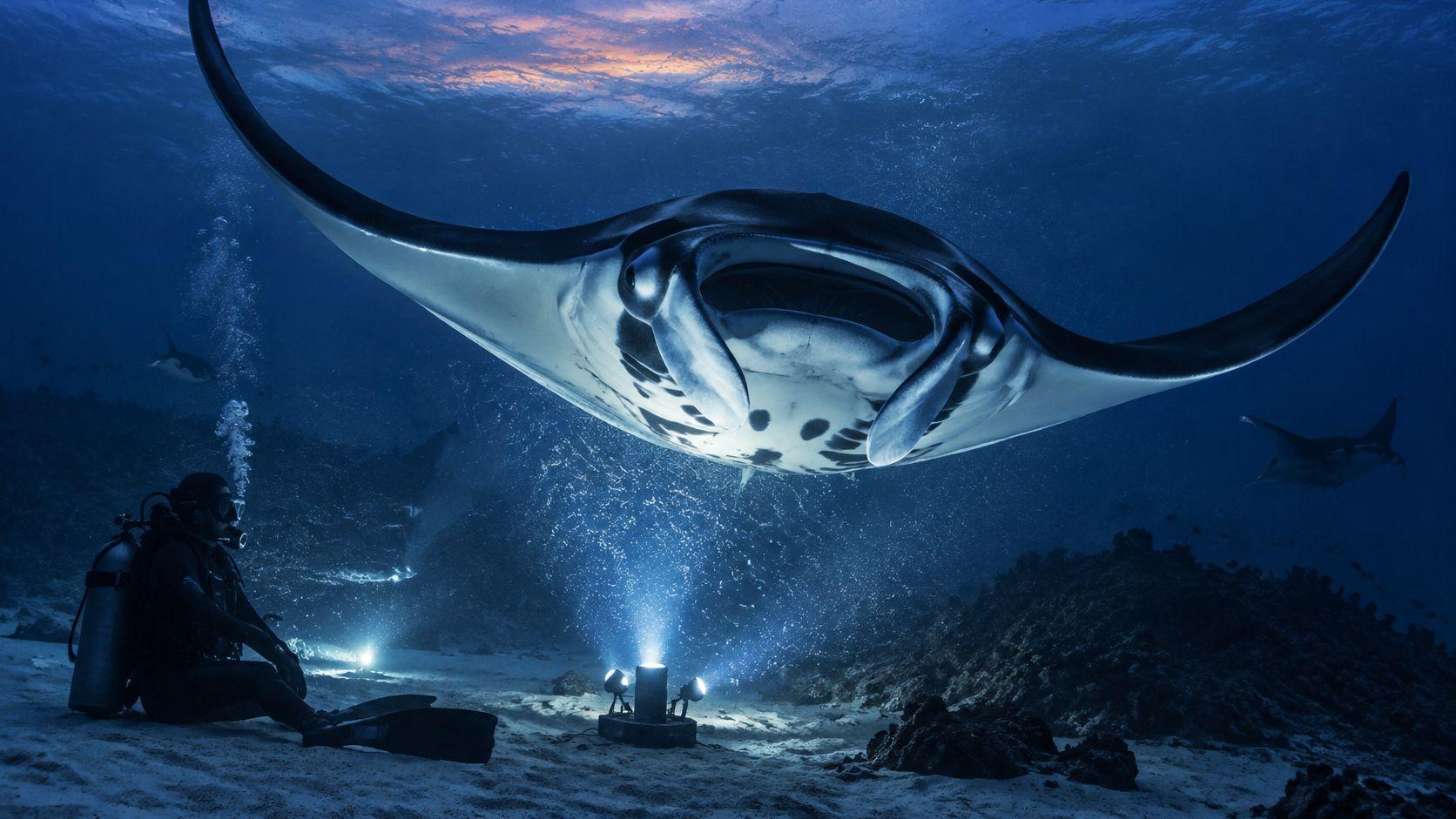
The advice you'll hear most often about the manta ray night dive in Kona is that it's a dark-water lottery. Book a boat, drop into black water, and hope a manta swings through the beam. That framing gets the mechanics wrong in both directions, because the water is lit on purpose and the evening follows a timetable you can build a holiday around. The mantas are the variable. The dive isn't.
Two things stay true on every departure. You'll spend the first dive in daylight and the second inside a pool of artificial light strong enough to see your gauges by. And nobody, whatever a website promises, controls whether the animals show up. What you do control is your preparation, your position on the sand, and your expectations.
Table of Contents
- Who Qualifies and How to Prepare
- Hour-by-Hour Plan for the Two-Dive Manta Night Trip
- Why Lights Make the Night Dive Bright, Not Dark
- How Often Mantas Appear and What Changes the Odds
- How to Behave Once the Mantas Arrive
- Price, Operators and Your Booking Decision
Who Qualifies and How to Prepare
Eligibility gets settled before you ever reach the harbor. Each rule exists because a guided night dive asks more of you than a relaxed daytime reef swim, and each one can be checked against your own logbook in about ten minutes.
Requirement — Rule — Why it matters
Certification — Open Water or higher, with proof — Confirms you can handle a night dive in a guided group
Recent diving — Dived within the last 2 years — Recent experience keeps buoyancy and gear skills current
Health — Good health, no heart conditions — Night diving adds physical and cardiac stress
Age — 18 or older, or 12 to 17 with a parent or guardian — Minors need an accompanying adult on the trip
Briefing and group diving — Comfortable in a guided group and able to follow a briefing in English — Safety depends on hearing the plan and holding the guide's position
The certification rule is simple: Open Water or higher, shown with a card or accepted digital proof. The recent-diving rule is the one that catches people, because two years can pass faster than expected between trips. Buoyancy works like a muscle memory skill: it fades when unused, and this dive asks you to stay low and still above the sand without stirring it up. If you are 12 to 17, plan to dive with a parent or guardian; divers under that range should look for a different format rather than assuming a seat on the standard trip.
Your pre-boarding checklist
- Certification card and logbook. The card proves your level, and the logbook dates answer the two-year question without a debate at check-in.
- Nitrox card if you plan to use it. Nitrox is free for certified divers; everyone else dives air in 80 cu ft tanks while the tank lasts.
- A refresher dive if you're near the limit. One supervised dive in the weeks before you fly resets mask clearing, weight checks and comfort in low light.
- Health honesty, especially around heart conditions. If a medical question is real for you, get it cleared before you build a holiday around the boat.
- Seasickness handled early. Take whatever works for you before departure, because tablets do little once the boat is rolling.
- A light meal plan for the surface interval. The sunset meal is light for a reason, and heavy food plus a swell is a bad pairing.
- Personal gear that fits. Tanks, weights and a dive light are included; bring the mask, computer and exposure protection you already trust.
If one line is shaky, treat it as a fixable gap. A refresher or a couple of guided day dives rebuilds recent experience, and a physician's clearance settles most health concerns. Preparation will not summon a manta, since plankton, site conditions and weather decide that, but it does put you in position to enjoy the lit night dive either way.
Hour-by-Hour Plan for the Two-Dive Manta Night Trip
The misunderstanding that trips up most first-timers is that you'll spend the evening in the dark. You won't. The first dive runs in late-afternoon light over lava tubes and reef fish, and the second happens inside a lit viewing area where visibility is rarely the issue. Guests board expecting a black-water plunge and get something closer to a floodlit stadium.
Stage — Timing — What happens
Boarding and departure — 2:45 to 4:00 p.m. — Board Honu One at Honokohau Harbor; departure depends on sunset
Reef dive — Late-afternoon daylight — Lava tubes and reef fish, with a 6 to 1 guide ratio
Surface interval — Around sunset — Light meal on deck and a briefing on how mantas live and feed
Cruise north — After the first dive — Boat moves to the manta site at Garden Eel Cove
Night manta dive — About 45 minutes — Settle on the sand around the lights and watch feeding mantas
Fallback dive — If no mantas appear — The second dive becomes a night reef dive
Return to harbor — 7:45 to 9:00 p.m. — Return time follows sunset
Manta Ray Night Dive departs from Honokohau Harbor aboard Honu One between 2:45 and 4:00 p.m. and returns between 7:45 and 9:00 p.m., an itinerary of roughly five hours that shifts with the sunset. Confirm the same window in your booking email for your own date, because the whole plan rotates through the year.
The reef dive is the part nobody asks about and everybody enjoys. You're in the water while the sun still lights the tubes, and a 6 to 1 guide ratio keeps the group tight enough to point things out. It doubles as a shakedown for your weighting and finning while the stakes are low.
How the five hours actually fill
The surface interval carries more weight than it looks. You eat a light meal on deck as the sun drops, then sit through a briefing on how mantas live and feed. That talk isn't decoration. It's where you learn your assigned spot, the light discipline expected of you, and why you stay low and still so the mantas come to you.
Then the boat cruises north to Garden Eel Cove. By the time you back-roll, the powerful lights are already drawing plankton into the water column below you, and the group settles on the sand in a fixed arrangement rather than swimming a transect. The dive itself runs about 45 minutes. If the mantas never show, the fallback is still a full guided night reef dive, so no version of the evening ends early.
Book the earliest night of your stay, not the last. Weather and swell cancel boats, and a spare evening on the calendar is worth far more than a discounted seat.
Three checks worth doing now. One, look up sunset for your travel dates and see where the departure window lands. Two, confirm that window in your booking email rather than assuming. Three, keep the following morning light, since you'll be rinsing gear close to 9 p.m.
Why Lights Make the Night Dive Bright, Not Dark
The moment many first-timers remember is arriving at the lit viewing area, where the lighting, the drifting fish and the mantas sweeping through the beams can make you forget you're diving at all. It feels closer to watching a feeding station switch on than to making an ordinary night dive.
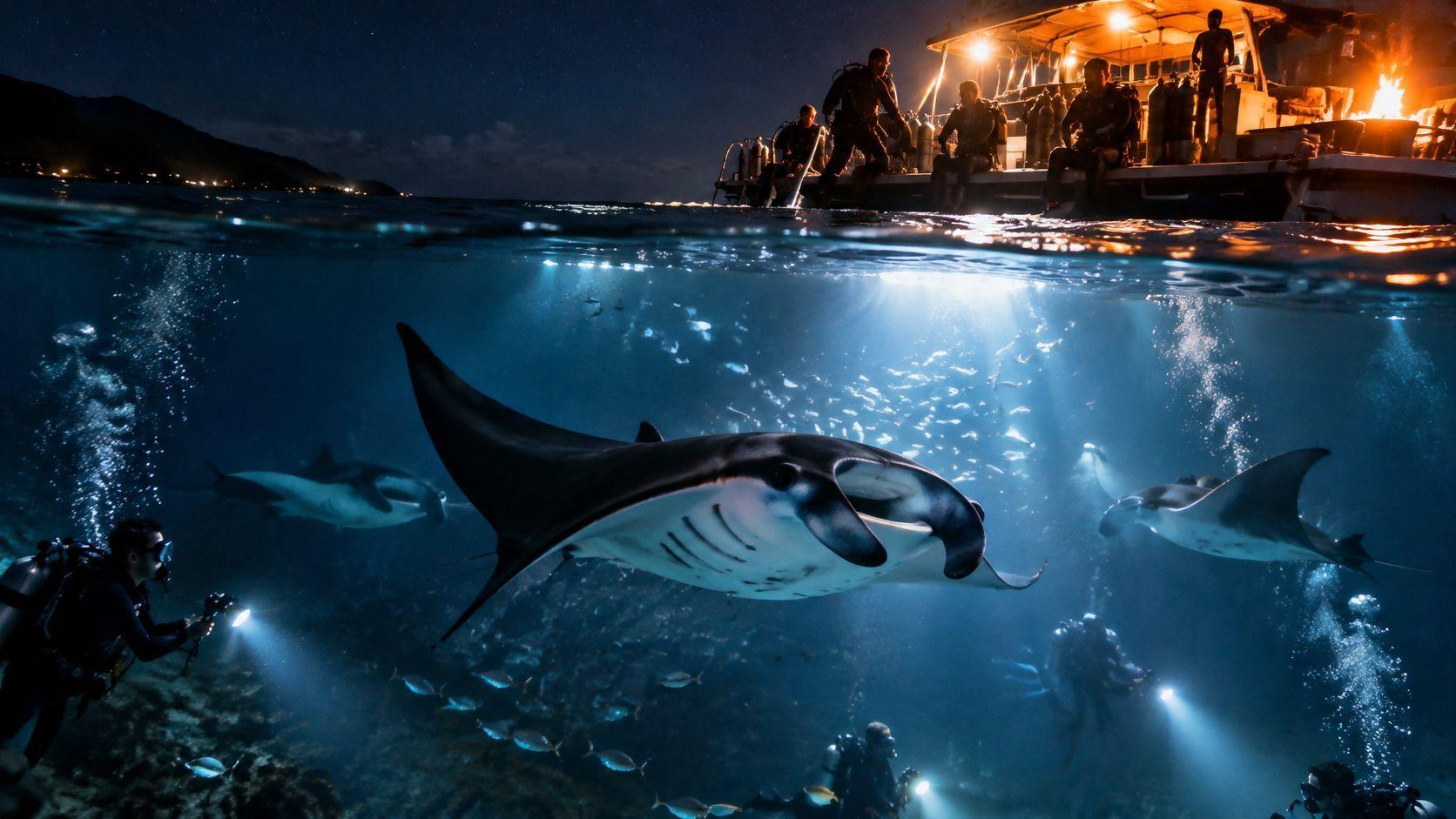
The beams do something unglamorous. A porch light on a summer night gathers moths; here, powerful lights gather plankton, concentrating tiny animals in a column above the sand. Mantas come for that food, and divers are the audience. The roughly 45-minute dive works because the group stays low and still while the current keeps delivering particles through the light.
What a manta is actually doing in the light
Manta rays are filter-feeding elasmobranchs, and their night behaviour follows prey density rather than the lamps themselves. They eat copepods, euphausiids, mysids, decapod larvae, shrimp and other plankton, swimming with their mouths open and using specialized gill rakers to trap particles while pushing water out. Work on reef manta rays summarized in a NOAA Fisheries giant manta ray framework found that feeding probability rose sharply once zooplankton biomass reached about 53.7 mg dry mass per cubic meter, more than twice the density calculated as necessary to meet their metabolic needs. A stationary light field, in other words, can build a genuine feeding station.
The same analysis is careful about the limits. Plankton distribution shifts with tides, currents, depth and the structure of the water column, so a lit station concentrates what is passing through rather than summoning what is absent. If plankton, site conditions or weather do not cooperate, mantas may stay away, and the second dive still becomes a guided night reef dive instead of a chase across the dark.
What you see from the sand comes in layers. Fine plankton drifts through the beam like dust in a projector light. Small fish work the edges. Then a manta crosses overhead, banks, and comes back through the same column, sometimes several times in a row. Your job stays simple: remain low, keep your light disciplined, and let the animal choose the route.
How Often Mantas Appear and What Changes the Odds
Here's where marketing and marine biology part company. A sighting percentage describes a monitored site over years, not a promise attached to your booking, and the difference matters when you're choosing a date and an operator.
Site or source — Nights with mantas — What it tells you
Manta Heaven, Kona monitoring — About 92% of monitored nights — A strong, consistent aggregation site, 2009 to 2014
Manta Village, Kona monitoring — About 78% of monitored nights — Reliable, but less frequent than Manta Heaven
Garden Eel Cove — About 80% of our trips; no published nightly rate — Generally supports larger aggregations; variable night to night
Those figures come from a six-year Kona manta site study that recorded 25,444 observations of 118 identified reef manta rays between January 1, 2009 and December 31, 2014, with mantas present on roughly 92% of monitored nights at Manta Heaven and about 78% at Manta Village. That supports one honest sentence: Kona encounters are highly likely, and never certain.
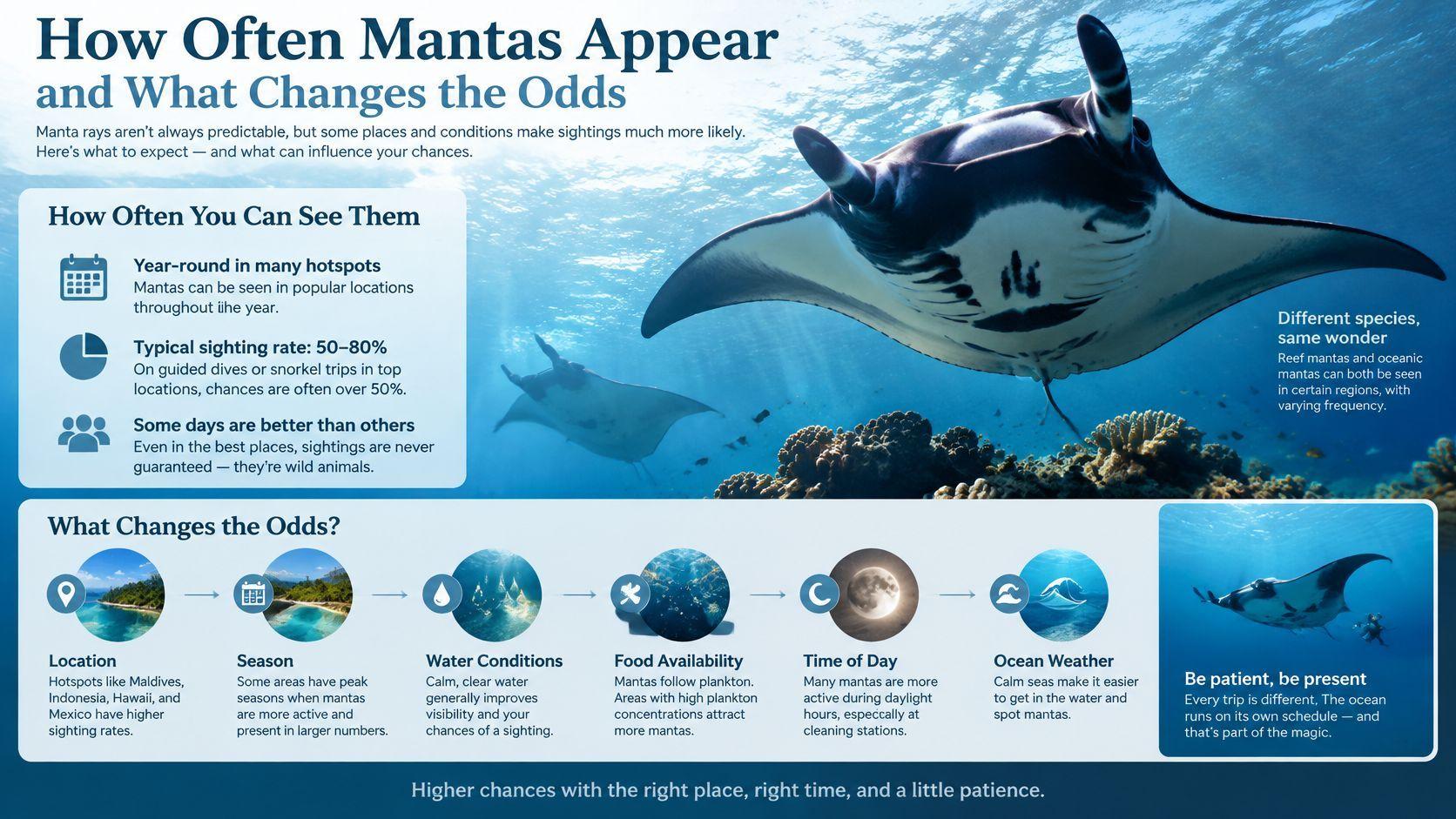
What moves the odds on any given night
Feeding conditions decide attendance. A 2025 University of Hawaiʻi study of more than 23,000 sightings of 167 individual reef mantas at Garden Eel Cove and Keauhou found that aggregation size tracked zooplankton density, identifying prey availability as the primary driver of manta presence and group size (University of Hawaiʻi ScholarSpace). The same work found the two sites differ in residency and sex-specific patterns, and that Garden Eel Cove generally holds larger groups.
So currents, season, swell and site choice move the outcome more than any promise does. A calm leeward evening with plankton stacking up in the lights is a different night from a stirred-up one.
A simple reading rule for the numbers goes like this.
- Treat 78% to 92% as likely, not certain. Those are monitored-night rates at specific sites, not a guarantee attached to your ticket.
- Check sunset and sea conditions for your date. An early-evening departure in settled weather is the friendly version of this dive.
- Count a sighting as a bonus. It changes how the whole evening feels when the water stays empty for the first twenty minutes.
On a night without mantas the second dive still happens, as a lit night reef dive. You get the bottom time, the beam full of plankton and the small fish working the light. It's a good dive, just not the one on the poster.
How to Behave Once the Mantas Arrive
A light station is a feeding opportunity, not a replica of the ocean. Stable-isotope work on giant mantas estimates that mesopelagic sources supply about 73% of dietary intake on average, against roughly 27% from surface zooplankton, which means these animals routinely feed deep and move vertically while they do it (Royal Society Open Science). Your job on the sand is to stay out of that traffic pattern.
- Settle before the lights peak. Reach your assigned spot early, get neutral, and stay there. Movement during the first passes costs you the closest ones.
- Stay low and still. Mantas approach a stationary group and give a moving one a wide berth.
- Keep your light on the water column. Sweeping a beam across an animal's face disrupts the feeding line and helps nobody.
- Don't touch, chase or follow anything upward. The instinct to rise with a passing ray breaks the arrangement for every diver behind you.
- Protect your buoyancy. A fin scrape on sand clouds the column and fouls the light for minutes.
- Mind boats, moorings and other divers. Follow your guide's positioning rather than finding your own angle.
- Report what looks wrong. An injured, tangled or strangely behaving manta should go to the crew the moment you're back on deck.
The one rule that covers the rest: be the least interesting thing in the water.
The trade-off deserves plain words. Written testimony on manta diving in Kona identifies stress, injury, disease, altered feeding and habituation as documented concerns around these encounters, while noting that artificial-light feeding itself may not be the primary threat, since boats, crowding, collisions and entanglement carry more of the risk (Hawaiʻi County records). That's why visitor education, quiet positioning and reporting problems do more for the animals than any badge on a website.
Price, Operators and Your Booking Decision
Our two-tank trip is listed at up to $299 per person, and that covers more than a seat. Two tanks of air or free Nitrox for certified divers, weights, a dive light, a guide for every six divers, a light meal at sunset, the manta briefing, and a hot shower with a marine head when you climb back aboard. We run as a PADI Five Star dive center, the trip is capped well below the vessel's rated capacity, and cancellations or rebooking are accepted until 72 hours before departure.
Four things move the final bill. Taxes and fees sit on top of the advertised rate. Pricing shifts with demand, so the same seat costs different amounts on different dates. A private charter changes the arithmetic entirely for a group. Nitrox is included here for divers who hold the certification, though plenty of boats treat it as a paid upgrade, so ask.
If our dates are full, other operators run two-tank manta trips out of Honokohau Harbor on a similar shape: an afternoon reef dive, a sunset surface interval, and a guided night segment. Compare them using the checklist below, and confirm each company's own cancellation window, inclusions and group limits directly, because those details differ boat to boat.
- Total cost after taxes and fees. Compare the number you'll be charged, not the headline rate.
- Tanks and weights included or extra. Gear rental changes the comparison.
- Guide-to-diver ratio. A smaller group means less silt and a calmer viewing line.
- Nitrox policy. Free with certification, or a supplement.
- Group size against boat capacity. A packed boat and a still boat produce different dives.
- Cancellation deadline. Know the hour, not just the day.
- How the no-manta night works. Refund, rebooking, or a reef dive.
Then do three things. Confirm your certification and how you'll prove it, since Open Water or higher with a dive in the last two years is the entry bar here. Compare the total cost on one basis across operators. Last, book early enough to pick a date with a workable sunset, and note the cancellation window before you commit.
Mantas appear on about 80% of trips, and a sighting is never guaranteed. The lit night dive happens either way.
Manta Ray Night Dive runs exactly this format from Honokohau Harbor: an afternoon reef dive, a sunset meal on deck, and a guided night dive at Garden Eel Cove where you settle on the sand and let the lights do the work. If you'd rather book a trip that tells you the honest odds than one that promises a sighting, Manta Ray Night Dive is the boat to join, and the waiver is the one thing worth finishing before you board.