
Manta Ray Night Dive Kona: What a Two-Tank Trip Involves
Manta Ray Night Dive Kona explained: timing, requirements, what to expect at Garden Eel Cove, sighting odds and how to choose a two-tank operator.
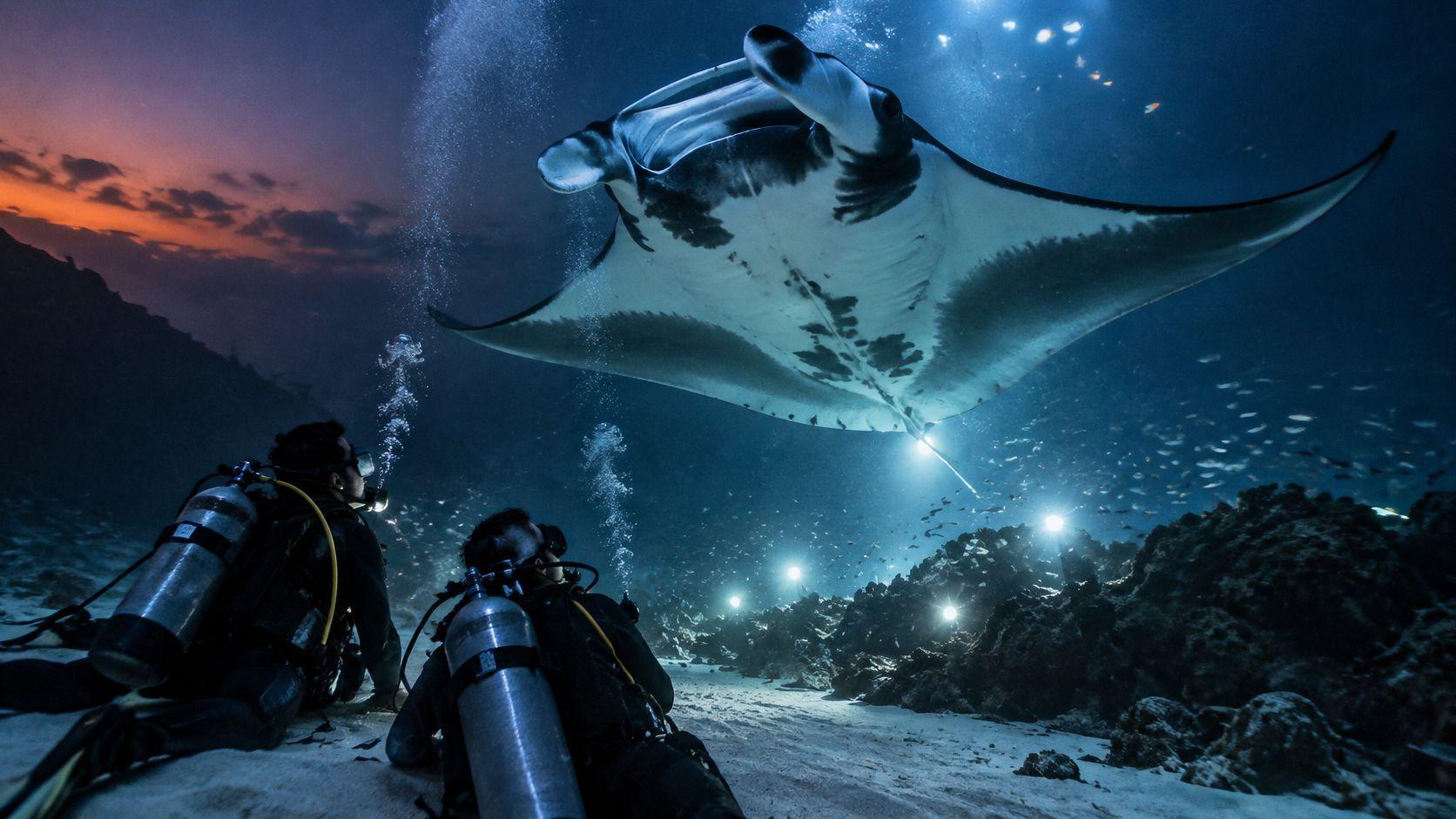
You've got the certification card, a week on the Big Island, and one evening still unplanned. Someone at the coffee shop said the manta ray night dive Kona boats run out of Honokohau Harbor is the thing they'd do again tomorrow. So you open a booking page and the details start to blur: two tanks, Garden Eel Cove, night dive, ages 16 and up, ages 12 to 17, guide ratios, Nitrox, five hours of your evening.
None of it is complicated once someone walks you through the trip in the order it happens. That's what follows: who gets on the boat, what each stage of the evening is for, why the mantas arrive at all, and how honest to be with yourself about the odds of meeting one.
Table of Contents
- Who Qualifies and What to Confirm Before Booking
- What a Two-Tank Manta Night Dive Involves
- Why Mantas Gather in the Light After Dark
- How to Position Yourself During the Night Dive
- How Often Mantas Actually Show Up
- How Night Safety Works on a Busy Site
- Comparing Kona Honu Divers as an Alternative
- Confirm the Price and Check-In Before You Book
Who Qualifies and What to Confirm Before Booking
The gate on this trip is a card and a logbook, not nerve. Every diver needs Open Water certification or higher and at least one dive logged in the previous two years. The format is also divers-only: snorkelers are not taken along on the two-tank night dive, so non-certified members of your group need a different evening plan.
That filter exists for a reason. An offshore dive after sunset asks more of you than a shallow day reef. You need steady buoyancy in the dark, you need to read hand signals at arm's length, and you need to stay with a buddy without a sunlit surface as your visual anchor. Kona Honu Divers, the PADI Five Star operator running the trip, handles this screening on the dock so that a busy site stays manageable once everyone is underwater.
Diver situation — What is required — Confirm before booking
Certified adult diver — Open Water certification or higher, with a dive in the last two years — Date of your most recent logged dive
Nitrox diver — Nitrox certification to use the free Nitrox on board — Bring your card and confirm it is accepted
Health — Good health with no heart conditions — Disclose any condition to the operator before departure
English speaker — Able to follow an English briefing — Ask about any other language support
Night diver — Comfortable in dark open water and able to follow crew directions — Consider a practice night dive if you are new to the dark
Teen diver aged 16 or 17 — Open Water certification or higher, with a parent or guardian along — Call 808-315-7114 to confirm the under-18 details
Diver under 16 — Not eligible for the Manta Ray Night Dive — Ask the operator about the guided night snorkel for younger family members
Health is a real question, not a checkbox. Good health with no heart conditions is the published standard. If you manage a condition with medication, raise it before departure rather than at the rail with your wetsuit half on.
Language matters more at night. The briefing is delivered in English, so you need to follow instructions in English without a translator in the water. Ask about other language support when you book instead of assuming it exists.
Dark water feels different from day water. Night diving isn't technically harder, but your reference points shrink to a beam of light. If you've never dived after sunset, a shallow practice night dive earlier in your trip removes most of the surprise.
The age rule is simpler than some listings suggest. The Manta Ray Night Dive is for ages 16 and up, and any diver under 18 must be accompanied by a parent or guardian. Younger divers are not eligible for this trip. If anything about a teen's booking is unclear, call 808-315-7114 and get the answer for your child before you pay.
Confirm three things before you commit: your certification level and most recent dive date, whether you hold the card for the Nitrox option, and the age rule for anyone under 18 in your group.
What a Two-Tank Manta Night Dive Involves
At Honokohau Small Boat Harbor in Kailua-Kona, the afternoon light has started to go gold and the crew is already stacking tanks. Guests check in, meet the captain, and get a briefing on manta biology and the history of Kona's rays before the boat leaves the dock.
The evening is one five-hour block built around two dives: a late-afternoon reef dive, a meal and briefing as the sun drops, then the manta dive itself. Kona Honu Divers publishes that shape on its two-tank manta dive itinerary, and it's worth reading as a sequence rather than a single event.
Stage — Typical timing — What happens
Check-in and departure — 2:45 to 4:00 p.m., depending on sunset — Crew briefing at Honokohau Small Boat Harbor, then the boat heads north
First dive — Late afternoon — Reef dive through lava tubes among reef fish in fading light
Meal and manta briefing — Between dives, as the sun sets — Light meal and a talk on manta behavior and feeding
Second dive — After dark, about 45 minutes — Divers settle on the sand near the lights and watch mantas feed overhead
Return — 7:45 to 9:00 p.m., depending on sunset — Boat returns to the harbor after about five hours in total
Why bother with a reef dive when the mantas are the point? Because it turns the boat into a known quantity before the water goes black. You check your weighting, your regulator, your mask seal and your buddy's hand signals in easy conditions, with lava tubes and reef fish as the warm-up. By the time you roll in for the night dive, you're repeating a routine instead of inventing one at 8 p.m.
The boat runs north along the coast to Garden Eel Cove, the site most Kona night boats work, and the departure window slides with the season. Sunset in December is not sunset in June, so the same trip starts close to 2:45 p.m. in winter and nearer 4:00 p.m. in summer.
Two practical notes for your calendar. Your confirmation email carries the exact check-in spot and time, and that's the number to plan dinner and driving around, not the generic window. Then look up sunset for your travel date, because it tells you how much daylight you'll have on the first dive.
Why Mantas Gather in the Light After Dark
Walk outside on a humid summer night and leave the porch light on. Within an hour the bulb has a halo of moths, and the geckos have noticed. Underwater off Kona the same principle runs with bigger actors: a light in dark water collects plankton, and the largest fish in the neighborhood arrive to graze.
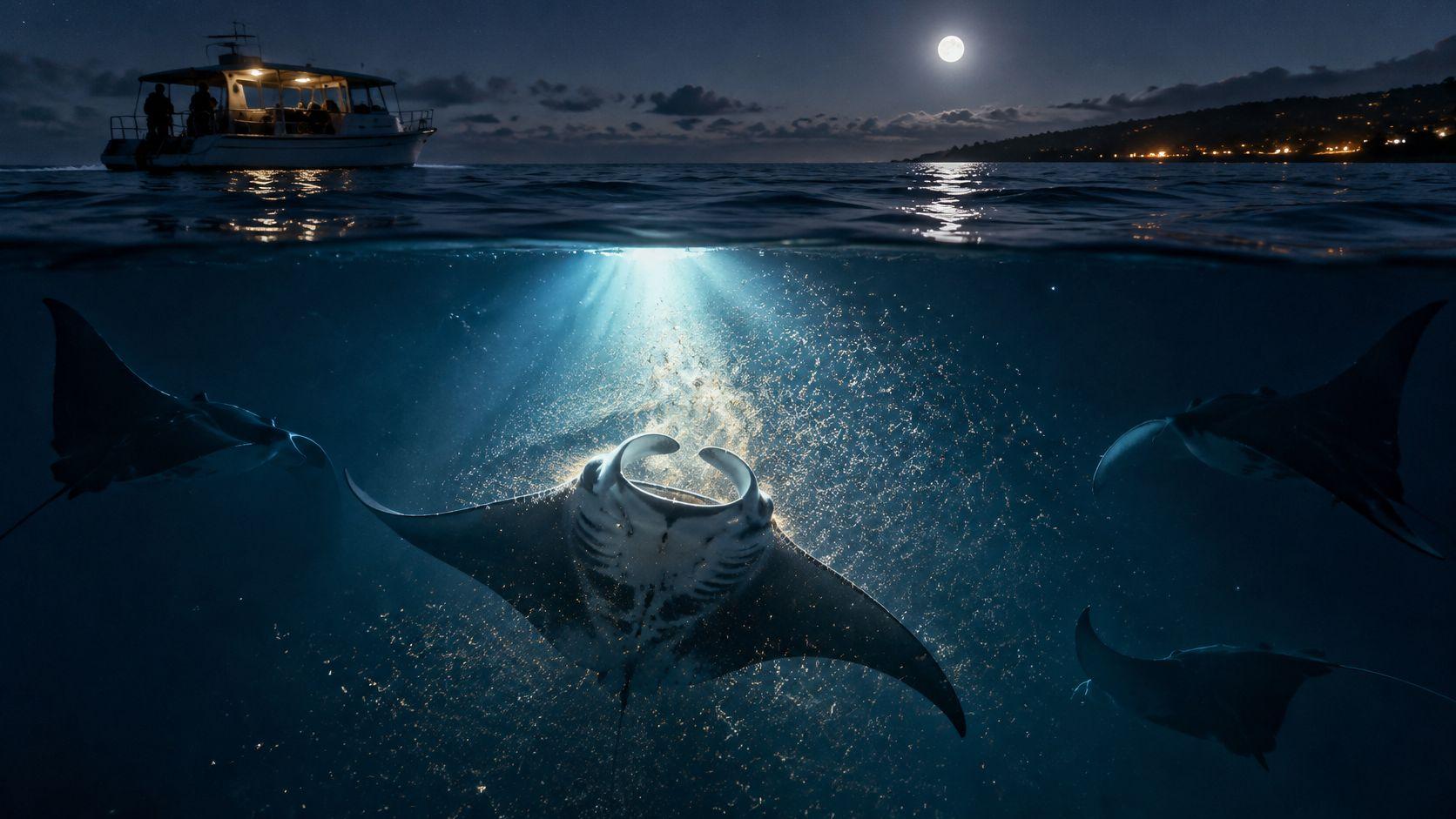
That's the whole trick, and it's worth breaking into parts.
- The lights concentrate prey. Underwater illumination raises the local density of zooplankton, including euphausiids, copepods, mysids, decapod larvae and shrimp, which are the primary prey of manta rays, according to a NOAA manta ray work product on the Kona aggregation.
- The mantas are built to harvest that patch. Reef mantas are specialized planktivores. They swim with cephalic fins extended, funneling prey-rich water into the mouth while on the move.
- The energy math favors the light. Large mantas need unusually high prey densities to meet their demands in nutrient-poor tropical water, so a lit water column becomes a profitable feeding station rather than a random stretch of ocean.
This isn't a handful of animals that happen to be passing through. A University of Hawaiʻi study analyzed community-sourced observations collected over 13 years, from 2010 through 2022, and logged more than 23,000 sightings involving 167 individually identified manta rays. Kona's nighttime gathering is a persistent feeding system with recognizable individuals, not a lucky coincidence.
The short clip below shows the geometry of a feeding pass, which is easier to recognize in the water once you've watched it on a screen.
Where you put your body matters more than what you do with your camera. The most productive position is stationary and near the lit area but not directly over it. Hovering above the light scatters the plankton, blocks the divers behind you, and puts you in the lane the mantas are using.
The lights raise the odds. They don't create a guarantee. What you get on a given night depends on how much plankton has gathered and whether the mantas choose to feed there.
That's why the briefing spends so long on stillness. You're not watching a show that runs on a schedule. You're sitting inside a feeding event that either happens or doesn't.
How to Position Yourself During the Night Dive
The crew's briefing sets the rules for the night dive, and following it closely is the difference between a calm encounter and a chaotic one. Here is the sequence in the order it happens underwater, with the reason each step exists.
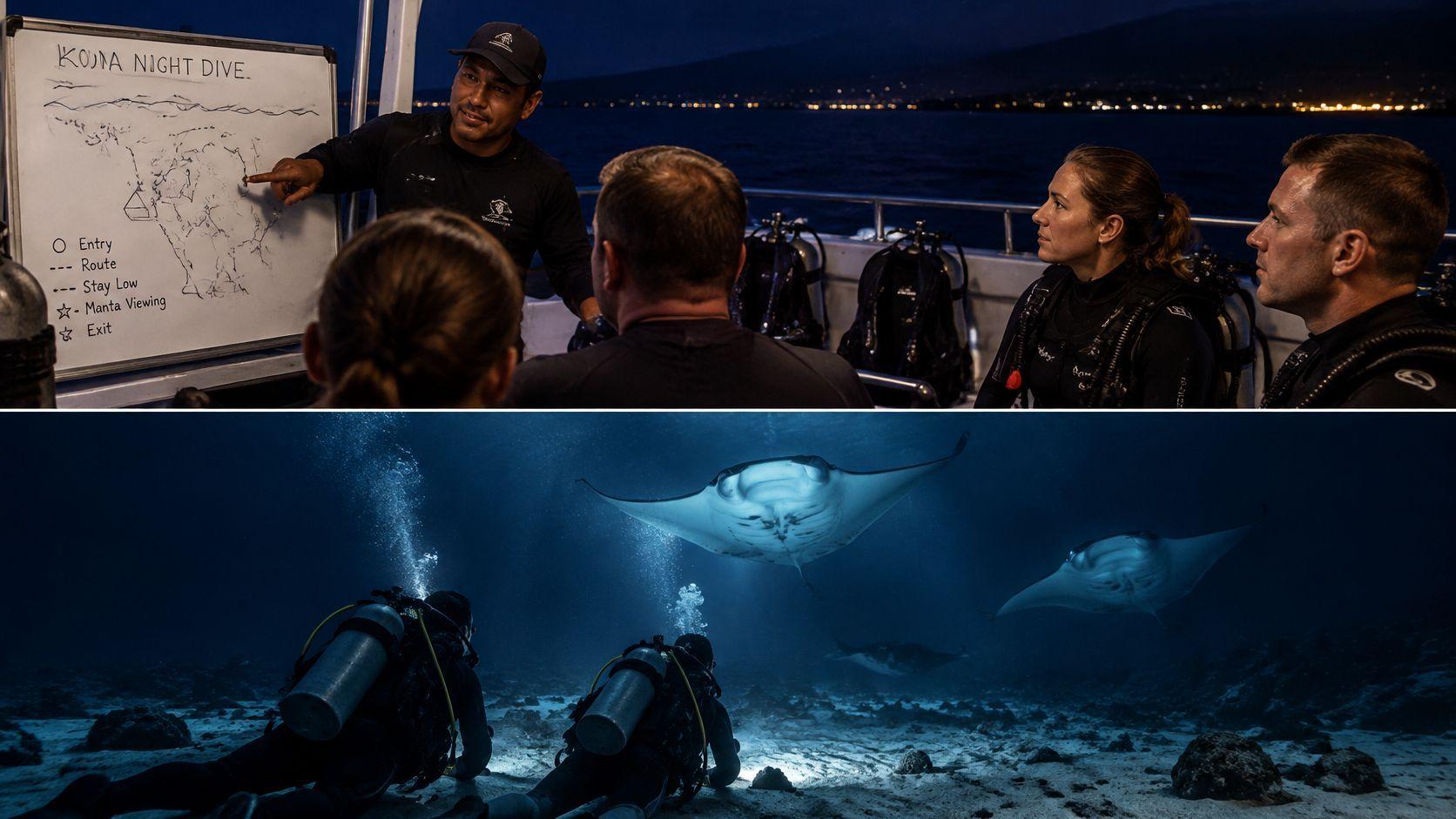
- Descend with your buddy and settle on sand, not coral. The group area is bare bottom on purpose. Coral is fragile, and a flat floor gives everyone a clear view without anyone kneeling on living reef.
- Stay low, with your body close to the bottom. A diver hanging mid-water blocks sightlines and sits in the path mantas use on their passes. Low and flat keeps the water column open.
- Hold your position with minimal finning and steady buoyancy. Movement stirs and disperses the plankton patch you came to see, and every extra kick is a fin near an animal's face.
- Let the mantas come to you. Don't chase, grab or touch them. The operator's guidance prohibits it outright, and physically a hand on a manta strips the protective mucus layer that keeps infection out.
- Keep your buddy in sight and watch the guide for signals. After dark, a light beam is your communication system. A quick sweep and a hand signal replaces everything you'd say with your mouth during the day.
- Ascend only on the guide's signal, and follow the group back. Unplanned ascents put you in boat traffic at the exact moment nobody on the surface expects a diver there.
Two mistakes account for most of the trouble. The first is kicking toward an animal for a closer look, which ends the pass and disturbs everyone else's view. The second is drifting away from the group to follow a manta off into the dark, which is how divers get separated on a site shared with boats.
A good dive looks quiet from above: a steady row of divers on the sand, one light beam moving slowly, and mantas looping through the glow again and again.
How Often Mantas Actually Show Up
A manta on every dive isn't something anyone can promise. Mantas appear on about 80% of trips, which means roughly one evening in five ends without a sighting. That figure is a track record across many nights, not a commitment for your date.
What moves your odds
Three variables do most of the work.
Plankton density comes first. Aggregation size rises and falls with zooplankton density across Kona's two nighttime aggregation sites, according to a 13-year analysis published in Environmental Biology of Fishes. More prey in the water means more mantas in the light.
Season comes second. The same analysis found seasonal zooplankton variation statistically significant, with higher abundance in summer corresponding to increased manta sightings. Summer dates tilt the odds your way. They don't lock anything in.
Site comes third, and it matters less than the first two. The boat cruises north along the coast to Garden Eel Cove, one of the two aggregation sites the analysis tracked. What the mantas find there on a given night depends on the plankton, and the plankton depends on conditions no operator controls.
Then there's the fallback, the part listings rarely spell out. If the mantas don't appear, the second dive becomes a night reef dive. You still descend after dark, still work by torchlight, still have a guide alongside you. The evening doesn't collapse because the wildlife declined to attend.
Before you pay, read the cancellation and rebooking terms on the booking page rather than asking a stranger online. That's the document that governs what happens if the water turns rough or the boat fills.
Book the trip for the dive, not for the photo. Then a manta is a gift instead of a verdict on your vacation.
How Night Safety Works on a Busy Site
A certification card proves you learned the skills somewhere. The part it leaves out is everything above you: boats moving in the dark and a crowd of snorkelers and divers sharing one lit-up stretch of reef. On a busy Kona manta night, that gap matters. The popular sites can draw heavy vessel traffic and a large number of people into a small area, all focused on the same circle of light.
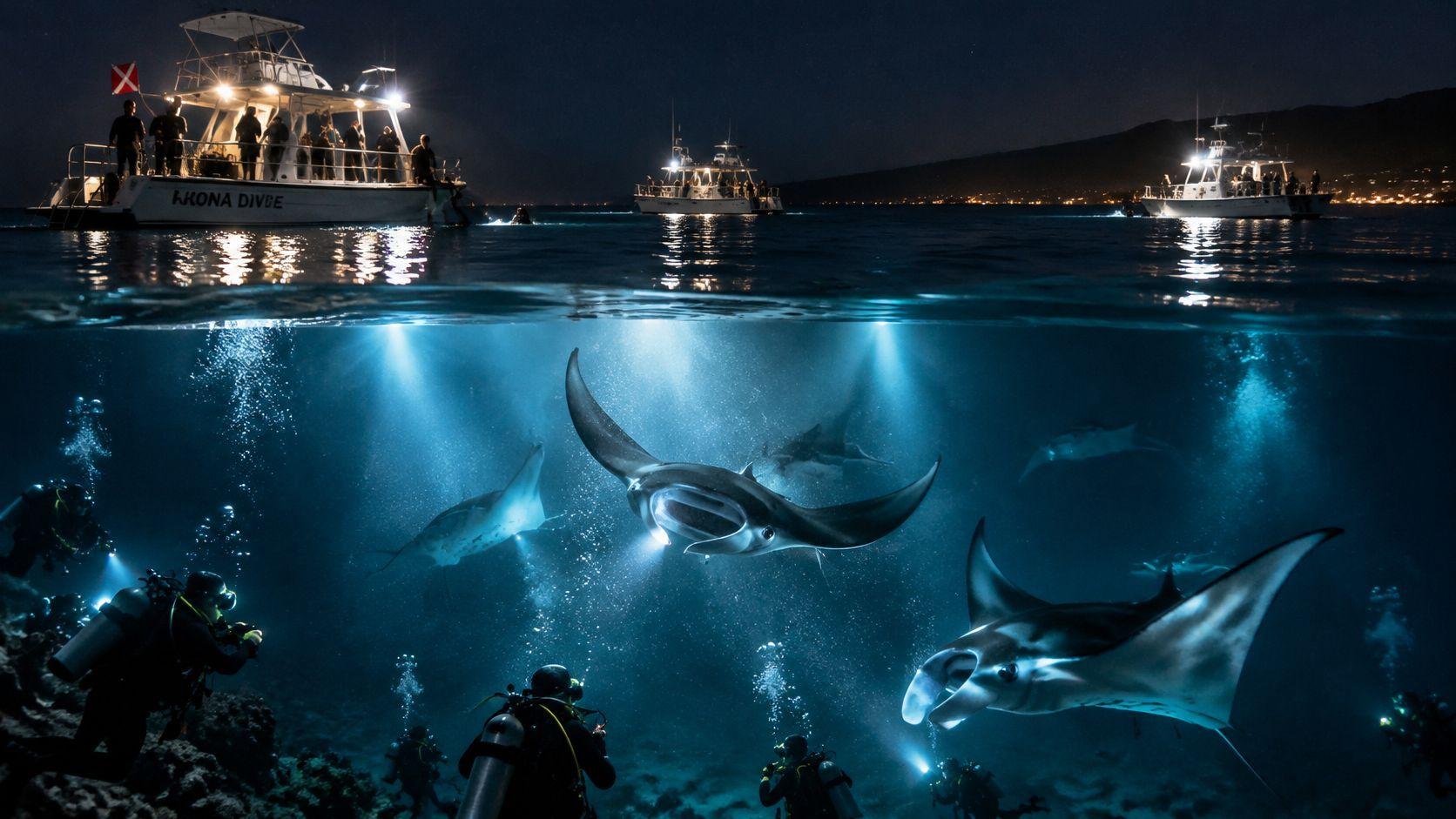
Crowding shows up in participant reports, too. Research cited in 2018 manta testimony to Hawaiʻi County found that 82% of respondents felt crowded by snorkelers, 78% by boats and 69% by scuba divers while viewing mantas. The pressure comes from every direction at once.
Does choosing the dive charter thin that out? Partly. The trip is for certified divers only, no snorkelers aboard, and the 16-and-up age rule (with under-18s diving alongside a parent or guardian) keeps the group small and experienced. That can mean more personal space and closer guide oversight on the bottom. The boats above you stay regardless, so ask the operator how many divers will share the site on your night.
Operator controls and diver controls
Night safety works like a two-layer system, and the layers are not interchangeable.
- Operator controls: the crew briefing, a guide ratio of one guide for every six divers, a cap of 18 divers aboard a vessel rated for 46 passengers, and a planned route with set group positioning.
- Diver controls: staying with your buddy, keeping your light visible from the surface, watching the guide, and knowing the lost-diver steps before anything goes wrong.
If you get separated, stay with your buddy, signal with your light, and follow the surfacing procedure from the briefing instead of swimming off to search. A diver who surfaces where the boat expects them is easy to find. One who surfaces 100 feet away is not.
Safe night diving needs more than a briefing. It needs separation from vessel traffic, a light that can be seen from the surface, and a group that knows what to do when something goes wrong.
Comparing Kona Honu Divers as an Alternative
If your search for this trip surfaced Kona Honu Divers, you have not found a competing operator. Manta Ray Night Dive is run with Kona Honu Divers aboard Honu One, departing Honokohau Harbor for Garden Eel Cove. Both names point to one excursion: the late-afternoon reef dive, the sunset meal and manta briefing, and the guided night dive.
The operator's published manta dive guidance describes a site briefing covering manta behavior, group positioning, light use and the rules that keep the animals undisturbed, and it states plainly that divers must not touch, chase, grab or block a manta. The same rules apply to your group regardless of which page you booked through.
Detail — What applies on this trip
Operator and boat — Kona Honu Divers runs the trip aboard Honu One, out of Honokohau Harbor
Trip structure — Late-afternoon reef dive, sunset meal and manta briefing, then the night dive at Garden Eel Cove
Minimum age — Certified divers aged 16 and up; divers under 18 dive with a parent or guardian
Certification — Open Water or higher, with a logged dive in the previous two years
Snorkelers — Not taken on this trip; it is divers only
Nitrox — Included free for divers holding the required certification
Sighting odds — Mantas appear on roughly 80% of trips; on a no-show night the second dive becomes a night reef dive
Free Nitrox is a bigger benefit than it sounds on a two-dive evening. A lower nitrogen load on the afternoon reef dive is one less variable to manage when you are settling onto the sand in the dark with a torch in your hand.
Read the sighting odds the way a guide would. Four out of five trips see mantas, which is good for a wild animal encounter, and the one in five still gets a real night reef dive rather than a cancelled boat. What no operator controls is whether plankton draws the rays to the lights on your particular evening.
The practical comparison, then, is not between two companies. It is between what a listing implies and what your confirmation email states. That email names your check-in spot and time at the harbor and locks in which age policy and cancellation terms apply to you. If a teen is in your group, get the age answer in writing before you pay, not at the dock.
Confirm the Price and Check-In Before You Book
The two-tank trip is priced at up to $299 per person, plus tax and fees, with demand-based variation. A two-tank listing also shows up to $259, so treat the figure on the booking page for your date as the one that counts. Confirm the full total, taxes and fees included, before you enter card details.
That price carries two tanks, weights, a dive light and a guide for every six divers, with Nitrox included for certified divers. The boat has a hot shower and a marine toilet, which earns its keep when you are rinsing off around 8 p.m. before the drive back to a condo.
Run this checklist in order.
- Certification and dive date. Open Water or higher, plus a logged dive within the last two years, and the card in your bag. The trip is divers only, so any snorkelers in your group need a different booking.
- Age policy. The standard trip is for divers aged 16 and up, and anyone under 18 dives with a parent or guardian. If your group includes a younger certified diver, call 808-315-7114 to ask what can be arranged before you pay rather than at the dock.
- Total cost. Verify the full price with tax and fees on the booking page for your date.
- Check-in details. Trips start at Honokohau Small Boat Harbor in Kailua-Kona, and the confirmation email gives the exact meeting spot and time.
- Sunset for your date. Departures run between 2:45 and 4:00 p.m. depending on the time of year, so the sunset on your date sets when you arrive.
Private charters are listed, and cancellations or rebooking are permitted until 72 hours before departure. If a policy reads unclear, settle it by phone before money changes hands.
Manta Ray Night Dive runs the two-tank evening out of Honokohau Small Boat Harbor aboard Honu One: an afternoon reef dive, a sunset meal and manta briefing, then a guided night dive at Garden Eel Cove. If the honest version of the odds above still sounds like your kind of night, call 808-315-7114 to check availability and confirm the details for your date. Bring your certification card, your logbook and a realistic expectation, and the rest is a quiet float in the dark.