
Garden Eel Cove: Kona's Manta Ray Night Dive Site
Garden Eel Cove in Kona is a top manta ray night dive site. Learn where it is, why mantas gather there, what happens on the dive and how to choose.
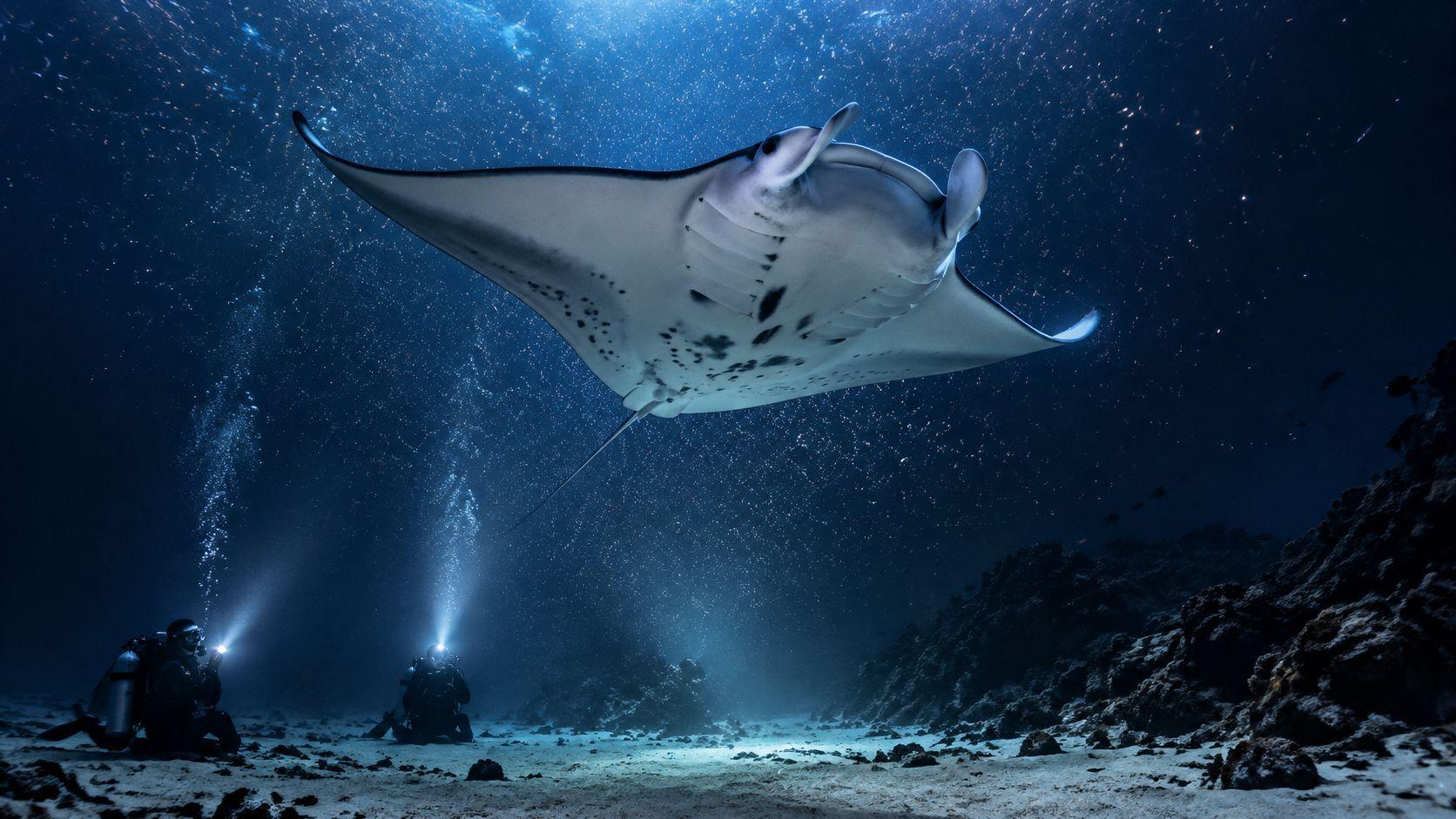
You're choosing an evening dive in Kona, and the photos all show the same extraordinary moment: a manta ray banking through a column of light just above a diver's head. What the photos don't show is the waiting, the careful positioning, or the possibility that the animals will feed somewhere else that night.
Garden Eel Cove is a wildlife encounter, not a scheduled performance. A good evening starts with understanding the site, trusting the crew's decisions, and knowing that a quiet dive and a spectacular one can happen at the same place on consecutive nights.
Table of Contents
- Garden Eel Cove at a Glance
- Why Manta Rays Gather Over the Sand After Dark
- Garden Eel Cove Versus Keauhou for Manta Viewing
- What Changes a Night Dive From One Evening to the Next
- Safety Rules for Divers, Snorkelers and Boats
- How a Night Dive at Garden Eel Cove Unfolds
- Choose an Operator and Book Your Night Dive
Garden Eel Cove at a Glance
Garden Eel Cove is a reef site on the Kona coast of Hawaiʻi Island, also called Manta Heaven or Makako Bay. It's one of Kona's established nighttime manta-viewing locations, alongside Keauhou, commonly called Manta Village.
The names can make trip descriptions confusing. If one operator says Makako Bay and another says Manta Heaven, they're referring to Garden Eel Cove, not separate destinations.
Garden Eel Cove site profile
Feature — What Readers Need to Know
Also known as — Manta Heaven or Makako Bay
Location — Kona coast, Hawaiʻi Island, about 20 km from Keauhou
Depth range — About 6 m (20 ft) to 21 m (70 ft)
Bottom profile — Basalt boulders, then coral reef, then sand
Daytime role — Reef fish and lava-tube exploration
Night role — Stationary manta viewing over a sandy area lit by underwater lights
The Hawaiʻi Department of Land and Natural Resources site description places basalt boulders at approximately 6 m (20 ft), with coral reef giving way to sand around 21 m (70 ft). Those are site-profile depths, not a promise that your manta observation area will sit at the deepest point.
The evening setting combines open water, fading daylight, and the anticipation of the night dive.
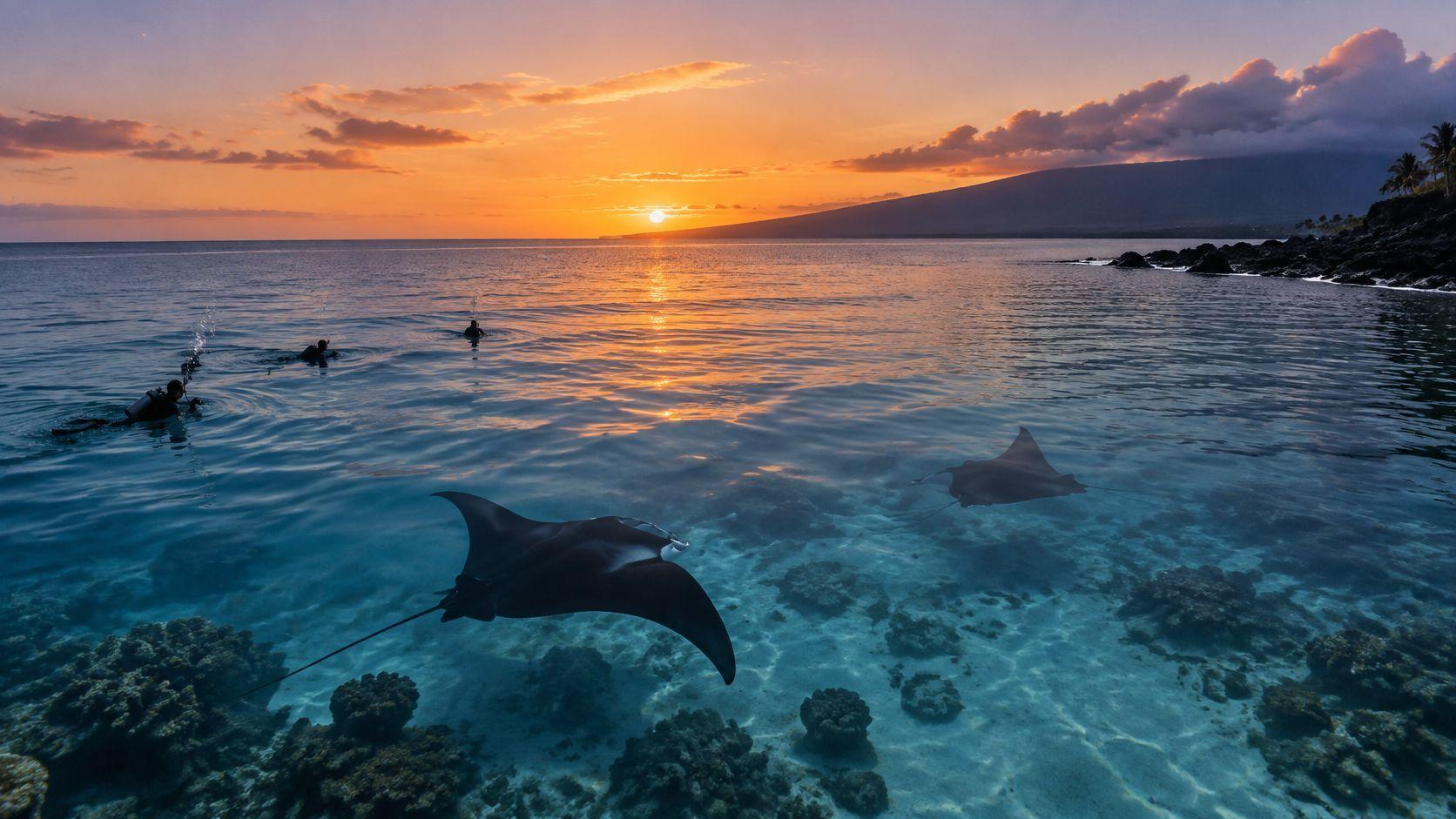
Different ground, different diving
During daylight, the boulder and reef terrain gives divers places to look for fish and explore lava formations. After dark, the sand provides a relatively unobstructed observation area, with room above the group for feeding rays.
Sand isn't permission to drop heavily onto the bottom. Maintain buoyancy, keep fins clear, and use the position your guide assigns rather than kneeling wherever you find space.
The takeaway: Garden Eel Cove serves as a daytime snorkel or dive site and a nighttime manta site. Our crew chooses between it and Keauhou according to where the rays are showing best.
Why Manta Rays Gather Over the Sand After Dark
Say you drop into the water just after sunset and the lights below you are already on. Kona's modern manta-night-diving tradition developed in the early 1990s, after operators noticed rays feeding on plankton concentrated by artificial lights, according to Kona Honu Divers' account of manta diving in Hawaiʻi. A porch light gathers moths, and a bird soon arrives where the insects have collected. The predator follows the food.
The illuminated water makes that relationship visible.
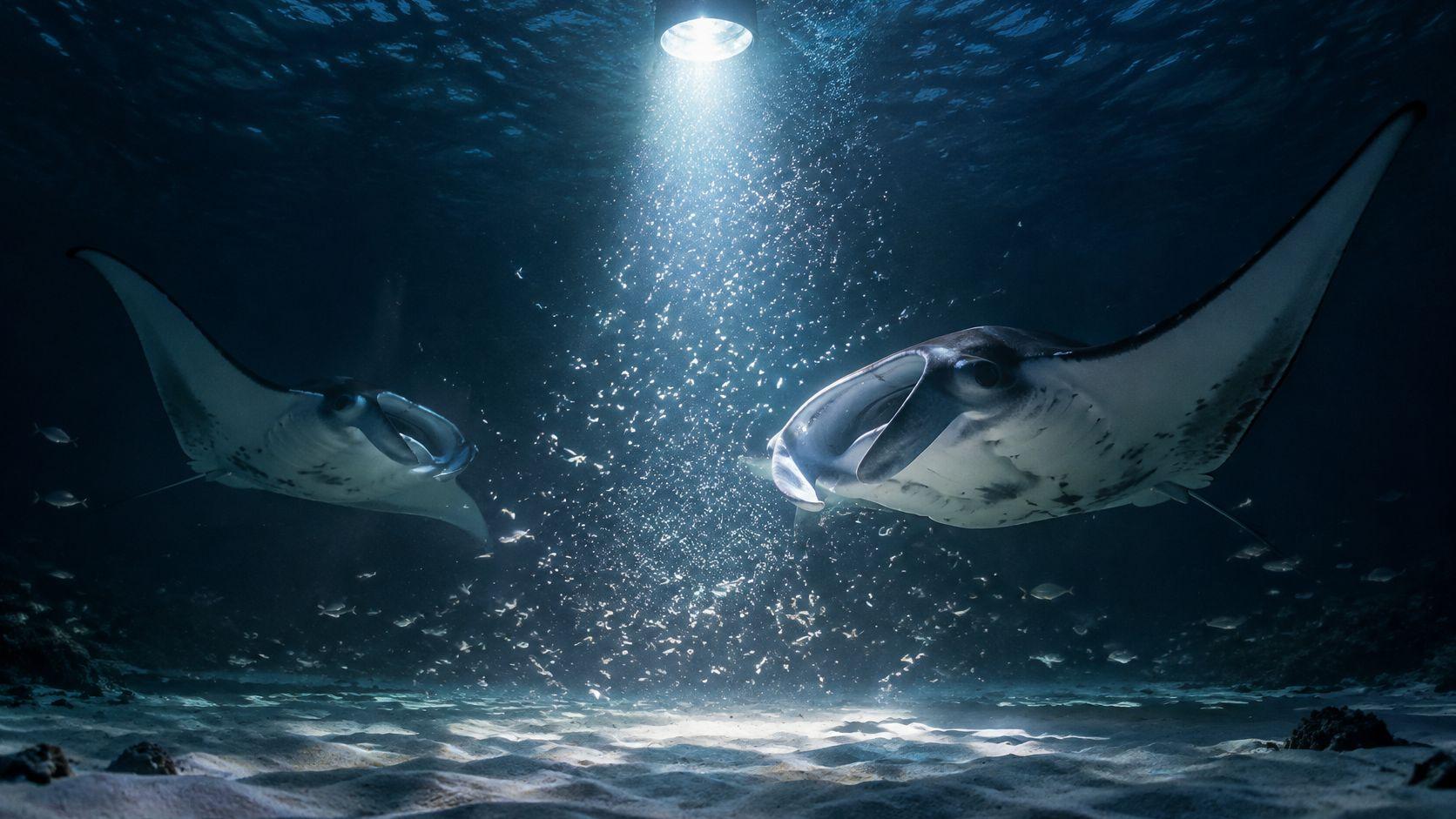
The lights do not attract the mantas. They attract plankton, and the mantas follow the food.
At Garden Eel Cove, underwater lights concentrate plankton above the seafloor, and reef manta rays move through that feeding patch, turning and returning while food remains available. The animals come for the plankton. Guests settle in to watch what happens next, without pursuing the rays.
A close pass reads differently once you see it that way. A ray banking overhead is choosing a route through food-rich water, and your job is to leave that route open.
From incidental encounter to managed activity
As manta viewing grew, managing people became part of managing the encounter. Hawaiʻi lawmakers have urged action on overcrowding, safety, and environmental concerns tied to manta viewing, and guides now assign each guest a position so the feeding lane stays clear.
The site has a daylight identity beyond its manta nickname. The sandy bottom can hold garden eels, so look across suitable sand during a daytime visit rather than treating it as empty ground between reef features.
Why the same site changes night to night
Plankton does not gather in the same density every evening, and that one variable explains most of what you will see. Three outcomes stay open on any given night: whether mantas appear at all, how many arrive if they do, and how close the interaction becomes. On a quieter evening the crew still deploys the equipment, guests settle into position, and the group watches what the animals choose to do. Wildlife often appears, and sightings cannot be promised.
That range is the honest version of this dive. Book expecting a feeding opportunity the animals might take, and a big night feels like a gift rather than a guarantee.
By day, divers explore the reef and observe life associated with the sand. By night, the sandy viewing area becomes the meeting point between the lights, concentrated plankton, and whatever mantas choose to arrive.
Garden Eel Cove Versus Keauhou for Manta Viewing
You have an evening available and two familiar site names on your shortlist. Garden Eel Cove and Keauhou are approximately 20 kilometers apart, and a peer-reviewed study of Kona's manta aggregations analyzed 13 years of observations from 2010 through 2022, including more than 23,000 sightings of 167 individually identified reef manta rays.
That record provides a more useful comparison than choosing between a dramatic photograph from one site and a visitor review from the other.
Garden Eel Cove and Keauhou compared
Factor — Garden Eel Cove — Keauhou
Typical aggregation size — Generally larger — Generally smaller
Night-to-night variability — Tracks zooplankton availability — Tracks zooplankton availability
Sex ratio of recorded sightings — Relatively balanced — 91% female
Study basis — 2010–2022, over 23,000 sightings of 167 identified rays — Same study
Garden Eel Cove generally supported larger and more variable aggregations. Keauhou's recorded sightings were strongly female-dominated, while Garden Eel Cove had a relatively balanced nightly sex ratio. These findings describe how animals used the locations, not different kinds of tours.
Choose for the situation, not a permanent winner
If your preference is the possibility of a larger gathering, and you accept that some evenings will be quieter, Garden Eel Cove is the usual pick. Its long-term pattern supports that preference without establishing what will happen on your booking date.
If the mix of animals interests you, Garden Eel Cove's more balanced nightly pattern is relevant. Still, don't expect a crew to select a particular mix of males and females for guests. Let the crew use either site as activity changes rather than treating the site name as an inflexible requirement.
Our crew chooses between the locations based on where manta rays are showing up best. That practical decision is more useful on the day than insisting on the location associated with someone else's exceptional encounter.
Booking perspective: A larger long-term aggregation doesn't mean more mantas on your particular night.
A quiet Garden Eel Cove visit doesn't contradict the study, and an active Keauhou evening doesn't overturn it. The findings describe patterns across years, not a reservation held by the animals.
What Changes a Night Dive From One Evening to the Next
Choosing the “best month” sounds like a way to remove uncertainty. It isn't. A University of Hawaiʻi study record found that aggregation size at the Kona viewing sites tracked zooplankton availability more closely than a simple calendar-season pattern, while still documenting seasonal and annual fluctuations.
Say another diver tells you that yesterday's viewing area was full of feeding rays. Tonight, the crew sets up the lights in the same place, but the feeding patch develops differently. The site hasn't stopped being useful habitat, and the crew hasn't necessarily done anything differently.
Currents may carry plankton through the area or move it elsewhere. Weather, moonlight, water conditions, and recent feeding activity may also influence the evening, but none should be turned into a confident prediction from the dock.
Separate the outcomes before you book
Promotional photographs often blend distinct questions into a single idea of success:
- Whether mantas appear. A sighting means an animal visited while your group was there. Wildlife often appears on our night dive, but sightings aren't guaranteed.
- How many arrive. An evening with a solitary feeding ray is different from an aggregation, even though both qualify as sightings.
- How close and prolonged the interaction becomes. A ray passing at the edge of visibility and a ray repeatedly feeding above the group produce very different memories.
This is why an advertised sighting rate isn't a promise of the photograph you have in mind. It doesn't, by itself, describe distance, duration, visibility, or the number of animals.
Give a quiet evening room to be worthwhile
If no mantas show on our outing, the second dive becomes a night reef dive. The crew still deploys the equipment, guests settle into position, and the group watches what the animals choose to do.
Before booking, ask what recent plankton and feeding conditions have looked like. Then ask how the operator handles a quiet night, rather than asking anyone to guarantee an active one.
Safety Rules for Divers, Snorkelers and Boats
Staying near the bottom and keeping your hands off the mantas are necessary, but they don't explain the whole setup. Divers, surface snorkelers, lights, and vessels share a confined nighttime space.
A Hawaiʻi County manta-viewing safety assessment noted that nighttime recreational or commercial swimming and snorkeling around actively maneuvering vessels lacked specific regulation despite inherent hazards. It also noted that commercial operators must obtain relevant state-ocean and harbor or launch permits. Permits don't replace careful on-site coordination.
Positioning rules by role at the site
Role or Item — Where to Be — Key Rule
Divers — Near the sandy bottom — Keep hands and fins controlled and avoid stirring sediment
Snorkelers — At the surface — Stay out of the feeding space below
Lights — Pointed upward — Aim lights upward, not at the rays
Bubbles — Away from the manta path — Position yourself so bubbles don't drift into a ray's route
Contact — Anywhere on the site — Don't touch marine life or chase rays
Boat crew — Clear of swimmers — Keep vessels away from swimmers in the water
Never hold your breath to avoid making bubbles. Breathe normally and follow the guide's positioning instructions so your exhaust is less likely to enter a manta's route.
Predictable guests make a manageable viewing area
Stationary observation leaves an open water column. A diver who suddenly kicks upward to follow a ray can enter the space used by both feeding animals and surface guests. Controlled fins also prevent a cloud of sediment from obscuring the group's view.
Light discipline matters for the same reason. Keep your beam where instructed rather than swinging it after each passing animal. Guides need to monitor people, not continually reorganize a group that's spreading out.
Ask about guide-to-diver ratios and how guides handle a guest who needs to leave early. Those operational details tell you more than a broad assurance that a trip is safe.
Conditions can change the setup
If the swell picks up considerably, our manta viewing takes place at a deeper campfire at 55 feet (17 meters). “Campfire” refers to the light-centered viewing arrangement, not an actual fire.
That adjustment doesn't make the encounter risk-free. Follow guide directions, stay with the group, and tell the crew immediately if you feel out of your depth, cold, anxious, or unable to hold position.
How a Night Dive at Garden Eel Cove Unfolds
Say you step aboard at Honokohau Harbor while the afternoon light is still warm. The evening ahead of you is a sequence of ordinary dive tasks rather than a leap straight into dark water: check equipment, listen, enter with your group, and let the guide set the pace.
Boat preparation is part of the experience, not just the wait before it.
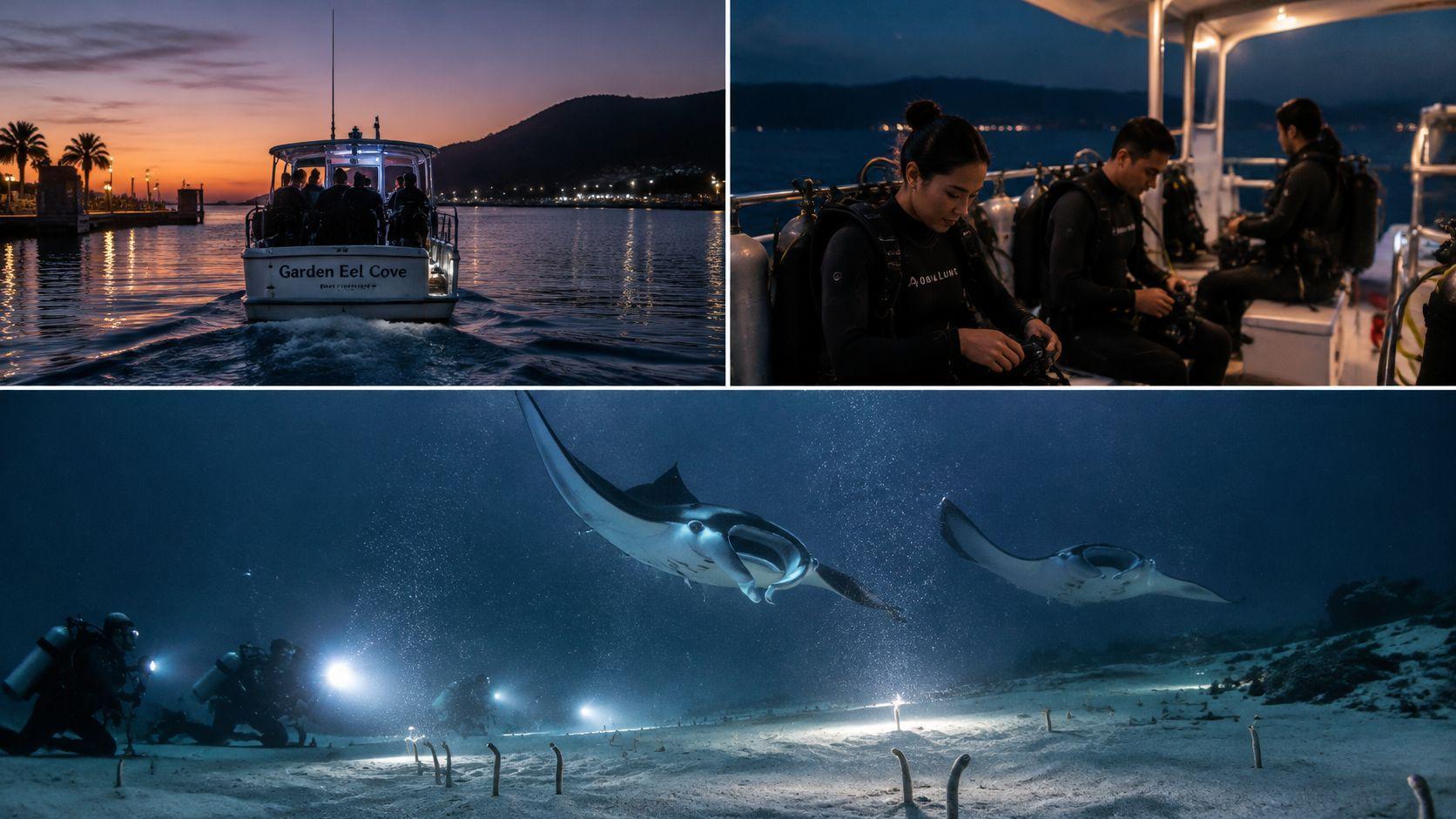
From harbor departure to the night dive
- Meet the crew and head offshore. Our departure is from Honokohau Harbor aboard Honu One, with the route continuing north along the coast toward Garden Eel Cove. The ride to the cove commonly takes 20 to 40 minutes, giving you time to organize equipment without rushing.
- Make the late-afternoon reef dive. Explore lava tubes and Hawaiian reef fish while the guide keeps the group together at a 6:1 guide ratio. The common slip is swimming ahead to investigate a feature, then making the guide divide attention between you and everyone else.
- Surface for food and the briefing. A light meal and a sunset interval separate the two dives. The briefing on manta biology and feeding behavior explains what you're watching and gives everyone the same plan before communication becomes hand signals and light beams.
- Re-enter after dark and take your assigned position. Guides use lights to attract plankton while guests settle around the sandy viewing area. Don't kick forward to close the gap with a ray; let the animal choose its approach.
- Stay still while guides monitor the group. Hold your position and let the plankton gather in the beams. Kona Honu Divers describes the same arrangement on its manta night-dive page, where guests watch without pursuing the rays.
- Allow for a site decision. If the initial site is quiet and activity is stronger at Keauhou, our crew may move when it's safe and practical. This is a crew judgment, not a reason for guests to pressure the captain into a transfer.
- Return together and board as directed. Keep following instructions through the ascent and boat exit. An exciting sighting doesn't end the dive; everyone still needs to get safely back aboard.
Why the same cove can feel different each night
The procedure never changes. The wildlife does. Plankton drifts and gathers unevenly from evening to evening, and the mantas respond to the food rather than to a calendar, so sightings can never be guaranteed.
Three separate outcomes decide how the night feels. First, whether mantas appear at all; if none show, the second dive becomes a night reef dive. Second, how many arrive, since a single animal cruising the lights is a different evening from several looping through together. Third, how close the interaction becomes, because the rays set the distance and some stay farther from the group.
On an active night, rays loop through the light while divers remain calm below. On a quieter one, the crew still deploys equipment, guests settle into position, and the group watches what the animals choose to do, often noticing the small reef life moving through the beams instead.
The dependable part is the procedure: a prepared group, attentive guides, and no pursuit of wildlife.
Choose an Operator and Book Your Night Dive
Say you're a certified diver comparing two evenings in Kona: a quick single-dive trip, or a full two-tank night with a reef dive, a sunset meal, and the after-dark session at Garden Eel Cove. The details you confirm before booking decide which evening you get. Start with certification, timing, and group type. You'll need Open Water certification or higher, a dive within the previous two years, good health without heart conditions, and the ability to follow an English briefing. Divers aged 12 to 17 join with a parent or guardian, while Junior Open Water divers aged 10 or 11 require a private guide arranged by phone.
Our guests meet the crew at Honokohau Small Boat Harbor, with departures between 2:45 and 4:00 p.m. and returns between 7:45 and 9:00 p.m., depending on sunset. For a fuller look at the format, review our manta ray tour guide before selecting a date.
The trip runs with Kona Honu Divers, and its published dive-tour details describe the same approximately five-hour, two-tank excursion from Honokohau Harbor: a guide, tanks, weights, and a dive light, with air or free Nitrox for appropriately certified divers. The manta night-dive description outlines the after-dark portion, where divers settle on the sand around lights that draw plankton. Snorkelers can watch the same site through the two-tank manta dive and snorkel outing, so shared and private night snorkel groups see the same rays.
What to confirm when you book
Detail — What it looks like
Group size — Small groups, capped at 18 divers on a vessel rated for 46 passengers
Guide ratio — One guide for every six divers
Included gear — Two tanks, weights, and a dive light; air provided, Nitrox for certified divers
Pricing — Advertised rates reach $299, varying with demand, plus taxes and fees
Private option — Honu Lele charter for up to 6 guests
Cancellation — Cancel or rebook until 72 hours before departure
If your group wants the boat to itself, ask whether the Honu Lele is available on your date and confirm the 6:1 guide ratio for your specific departure.
Book with honest expectations
Plankton shapes the evening more than the calendar does. Three separate outcomes decide how a night at Garden Eel Cove plays out: whether mantas appear at all, how many arrive, and how close they choose to pass. Sightings are reported on roughly 80% of trips rather than promised, and when no mantas show, the second dive becomes a night reef dive. Ask about recent feeding activity when you call, and treat a quiet evening as a dive with solid procedure rather than a lost one.
Book early for your preferred sunset-timed departure, and call us at 808-315-7114 if you need help matching the right arrangement to your group.
Manta Ray Night Dive offers a guided evening combining a late-afternoon reef dive, a sunset meal, and an after-dark manta encounter at Garden Eel Cove when conditions and activity favor the site. Visit Manta Ray Night Dive to check availability and plan your outing with clear expectations about the diving, the safety procedures, and the wild animals you may meet.