
Manta Ray Dive Kona: Two-Tank Night Dive Guide
Plan your Manta Ray Dive Kona trip: two-tank timing, eligibility, safety rules, Garden Eel Cove viewing and how to compare operators before you book.
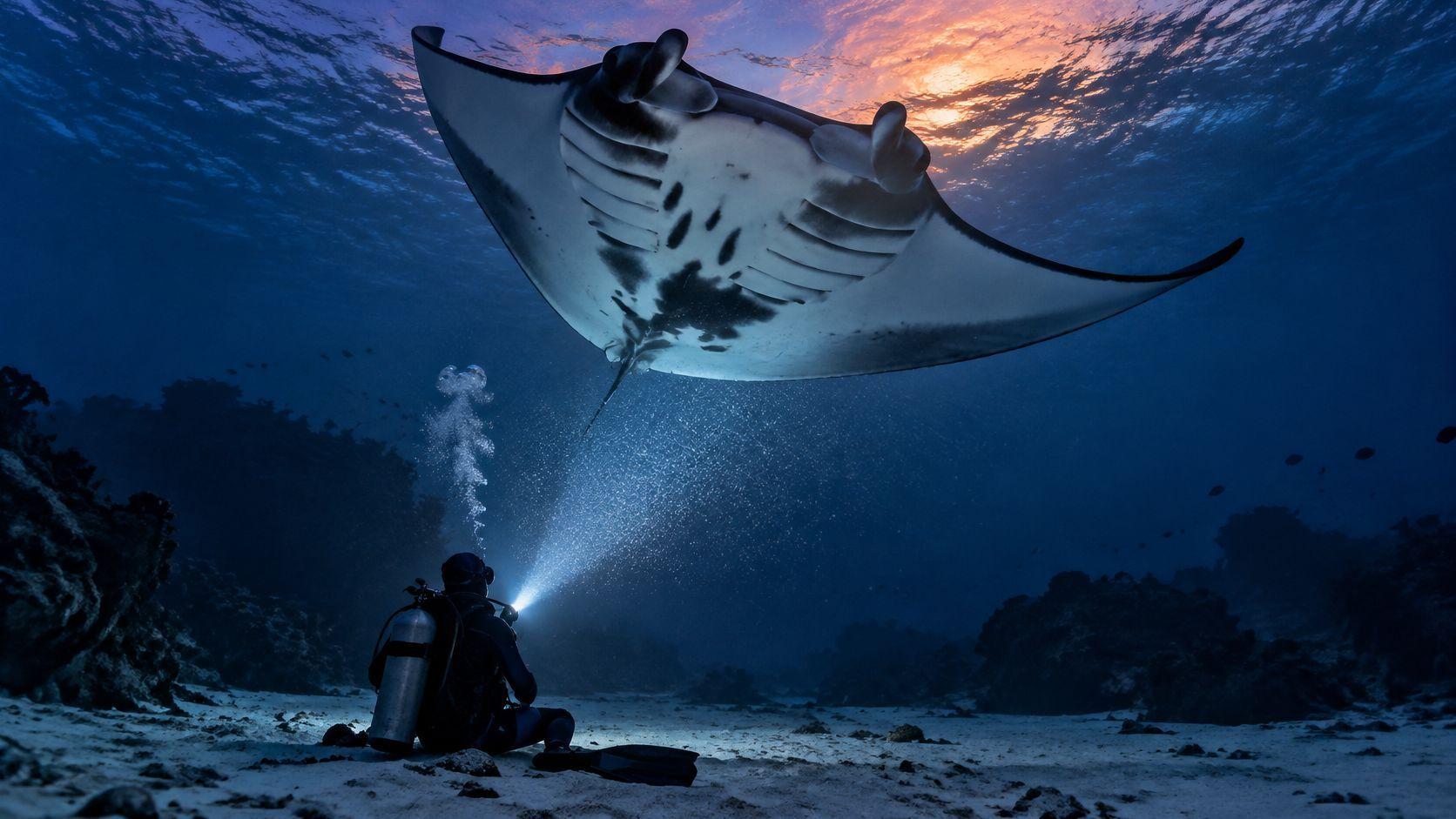
The sun sets over the water off Kona in the late afternoon, and the ocean darkens quickly once it passes. You have a certification card in your wallet, a 16-year-old with a new Open Water card who must dive with a parent or guardian, and one open evening on the island. Someone at the condo pool says the mantas came within arm's reach. Someone else paid for the boat ride and watched empty water.
Both outcomes happen. Manta sightings are likely, never guaranteed, and this manta ray dive Kona trip is for certified divers only. It is a feeding event shaped by light, plankton and diver behavior. The first two belong to the reef. The third belongs to you.
That makes preparation part of the booking. Your proof of certification, comfort after dark, gas planning and ability to hold still around the lights all shape the encounter. Arrive ready to control your position and beam, then let the mantas choose how close they come.
Table of Contents
- Two-Tank Manta Ray Night Dive Timeline
- Eligibility and Equipment by Diver Type
- Is an Open Water Diver Ready for Darkness and Crowds
- Why Mantas Gather at Garden Eel Cove After Dark
- Nitrogen, Nitrox and Gas Reserves on a Two-Tank Dive
- How to Behave During the Stationary Night Dive
- Comparing Price, Included Gear and Kona Honu Divers
- Confirm Your Booking and Check-In Details
Two-Tank Manta Ray Night Dive Timeline
A manta night dive doesn't begin after dinner. It begins in daylight, and the schedule is set by the sun, not by the clock on the wall.
Check-in at Honokohau Small Boat Harbor runs between 2:45 and 4:00 p.m., and the exact meeting spot and time come in your confirmation email rather than on the booking page. That window shifts through the year because sunset shifts through the year. A winter departure leaves earlier, a summer one later, and both end up over the same reef after dark.
The first dive is the warm-up you didn't know you wanted: a late-afternoon reef session among lava tubes and Hawaiian reef fish, in good light, with no mantas in the water to distract you from your buoyancy and your gauge. Then the boat moors, the light meal comes out, and the crew walks the group through manta biology and how the feeding works.
The Part Everyone Asks About
The second dive is the one you booked. Divers settle on sand near Garden Eel Cove, arrange themselves in a loose semicircle around the lights, and stay there for roughly 45 minutes. No swimming, no navigation, no compass work. Then a short ascent, a head count, dry layers, and the run home.
Stage — Typical time — What happens
Check-in and departure — 2:45 to 4:00 p.m. — Board at Honokohau Harbor; exact spot is in your confirmation email
Afternoon reef dive — Late-afternoon light — Guided reef dive among lava tubes and Hawaiian reef fish
Sunset surface interval — Between dives — Light meal and manta briefing on biology and feeding
Night manta dive — After dark, about 45 minutes — Stationary observation on the sand near Garden Eel Cove
Return to harbor — 7:45 to 9:00 p.m. — Return timing shifts with sunset
Fallback if no mantas appear — Second dive slot — Night reef dive instead
Return times land between 7:45 and 9:00 p.m., and that spread is the most useful thing to check before you commit to a date. A later departure doesn't cut the manta portion short, because both the sunset and the later sailings work the same site. You're choosing a start time, not a different dive.
When the Mantas Don't Show
Wild animals don't take bookings. Kona Honu Divers' published tour details report manta sightings on approximately 80% of trips, which means roughly one evening in five turns into something else. What happens on those nights matters more than the percentage. The second dive becomes a night reef dive, a real dive with a plan, a guide and a purpose, rather than a shortened trip or an argument at the dock.
The same page lists the manta dive at up to $299 plus tax and fees, names Garden Eel Cove as the preferred site, and advises guests to confirm current pricing and availability. Take that seriously. Rates move with demand, and a figure you read in a forum thread last spring isn't a quote.
Practical rule: Read your confirmation email the morning of the trip, not in the parking lot. The harbor has more than one loading area, and the check-in time is earlier than most people guess.
Three things to do when you book: note the departure window for your specific date, save the check-in instructions offline, and pack a warm layer for a wet ride back after dark.
Eligibility and Equipment by Diver Type
Most booking questions about a manta ray dive Kona trip have one answer. You need Open Water certification or higher, you show proof on the day, and you have a recent logged dive that the operator confirms at booking.
That's the default, and it covers the majority of adults who call. The exceptions are where bookings go sideways, so check your own situation against them before you put down a deposit.
Diver type — Requirement — Practical note
Certified adult diver — Open Water or higher, shown with proof; recent logged dive as confirmed by operator — Bring your certification card
Nitrox user — Nitrox qualification required to use the included Nitrox — Without it, the included gas cannot be used
Snorkeler — Not taken on the dive; surface viewing runs as a separate trip — Ask the operator how to book
Nitrox, Teens and the Age Question
The Nitrox question catches people out. Nitrox comes included on the two-tank trip for divers who hold the certification, and it can't be used without it. If your card says Open Water and nothing else, you'll dive air, which is perfectly fine. Don't assume you can talk your way into a richer mix on the dock.
Families need a second look at the age rules. Our manta night dive is listed for ages 16 and up, with divers under 18 accompanied by a parent or guardian. Other published listings allow 12 to 17 with a guardian, and Junior Open Water divers aged 10 to 11 only with a private guide arranged in advance by phone. If your teenager's card says Junior Open Water, that call happens before you book, not at the harbor rail.
Health and language matter too. The trip asks for good health, no heart conditions, and enough English to follow a briefing on a moving boat in the dark. A briefing you half understand is a safety problem, not a language preference.
What's in the Bag and What Isn't
Tanks, weights and a dive light come with the trip. Your mask, fins, snorkel, exposure protection and certification card do not. Kona water is warm at 3 p.m. and cool at the end of a 45-minute stationary dive, so a 3 mm suit or a dive skin over a rash guard is the difference between comfortable and shivering through the best part.
Snorkelers aren't taken on the dive itself. Surface viewing runs as its own trip, so if your group is split, ask at booking which departure handles the snorkelers and where they meet.
Before you pay, match your certification, your logged experience and your gear against the operator's current list. The list changes. Your card doesn't.
Is an Open Water Diver Ready for Darkness and Crowds
A certification card proves you finished a course. It proves nothing about holding still a foot off the sand in the dark, with several boats' worth of divers and snorkel groups sharing one lit patch of water, while a large animal feeds an arm's length over your head.
That gap is the question operator pages skip. Eligibility gets answered clearly and readiness barely gets mentioned, and the honest answer is that darkness is the easy part. The hard part is the crowding. Your light discipline, your buoyancy and your position decide whether the mantas keep working the lit water or veer off, and whether the diver beside you gets a clean view or a face full of fins.
Management research lands in the same place. University of Hawaiʻi research on manta viewing management identifies overcrowding, swimmer safety, vessel activity and coral damage from anchoring as the central concerns at Kona's manta sites, with proposed responses including mooring requirements, limits on commercial use, restrictions on vessel rafting and controls on live boating. Read that list again. None of it is about the dark. All of it is about boats, bodies and behavior in a small piece of water.
A Readiness Check You Can Run Yourself
Answer these tonight, before you book.
- Recent logged dives: you've been underwater within the past year, ideally within six months.
- Low-visibility comfort: you've dived in murk without your breathing rate climbing.
- Stillness: you can hold a position off the bottom for about 45 minutes without drifting into coral, a buddy or the lit column the mantas are feeding through.
- Air discipline: you check your gauge on a rhythm, not when you feel short of breath.
- Signal fluency: you can read and give hand signals and use your light to get a guide's attention without sweeping the beam across the group.
Four out of five is a conversation with the crew before you commit. Three out of five is a daytime reef dive first.
A diver whose last logged dive was a decade ago sits in exactly the same spot as one certified last spring. A refresher session or an easy morning reef dive the day before does more for your night than any gear upgrade.
For the sequence from the water's point of view, this manta ray night tour walkthrough shows what the dive looks like from the sand.
If you can hover still, track your air and follow hand signals in a group, the night dive suits you. If any of those three is shaky, fix it in daylight first.
Why Mantas Gather at Garden Eel Cove After Dark
The sun is gone, the reef has gone quiet, and then the dive lights come on. Within minutes a column of drifting specks builds above the sand, and the first manta arrives from outside the beam, banks, and loops back through the brightest part of it with its mouth open.
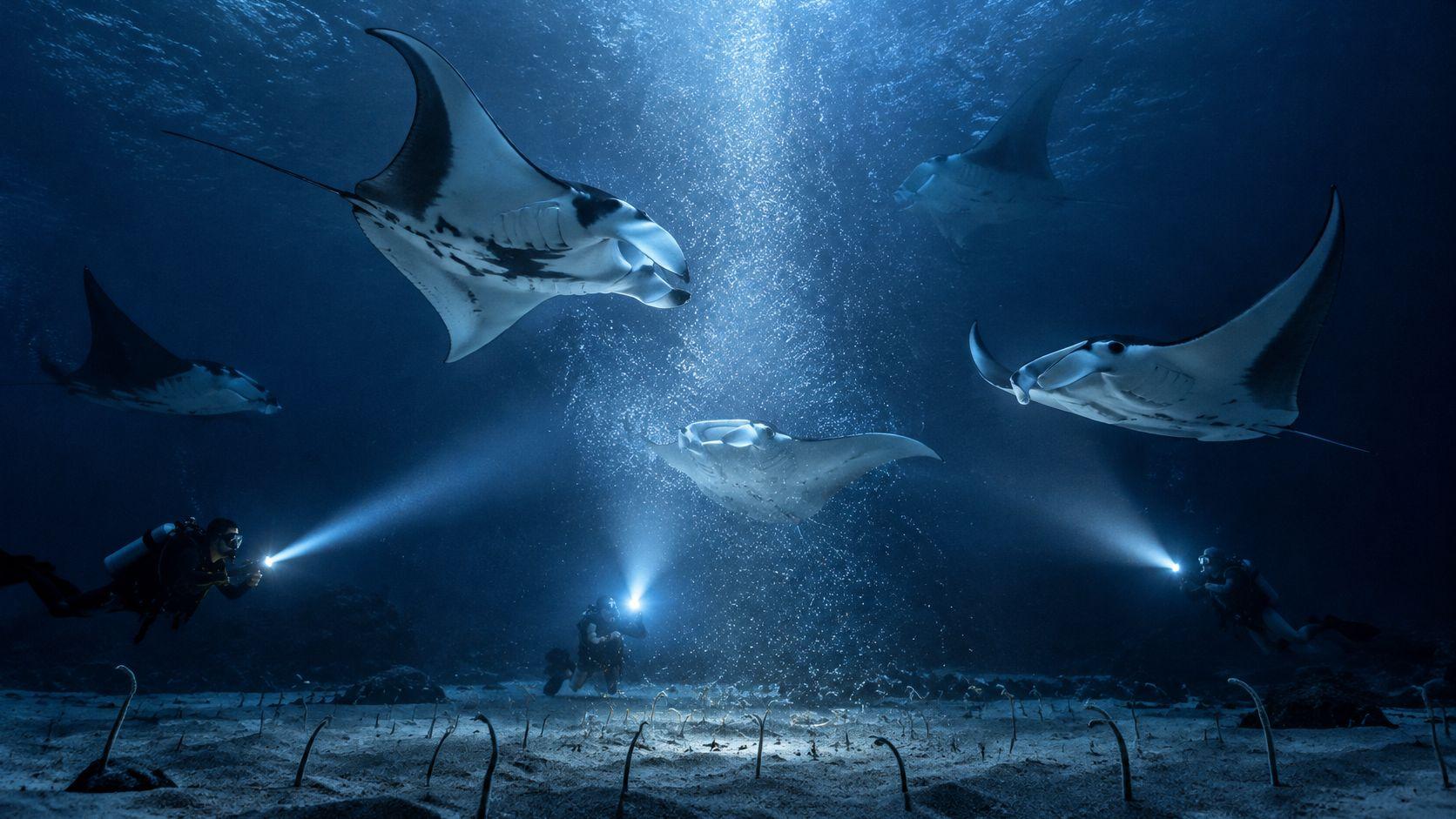
That isn't luck. It's a feeding event on the Kona Coast of Hawaii, and the light is the reason it happens.
The Light Builds the Food Patch
Artificial light pulls zooplankton into a concentrated feeding zone, and reef mantas filter-feed through it. The pattern repeats night after night, which is why the same animals return to the same patch.
Think of the lamps as an open kitchen at a hotel buffet. Nobody hands out menus. The food goes out, the doors stay open, and the guests arrive on their own schedule.
The evidence is unusually clean. A 13-year analysis of Kona observations from 2010 through 2022 recorded more than 23,000 sightings involving 167 individually identified mantas across two nighttime sites, and the peer-reviewed analysis of Kona manta aggregations found Garden Eel Cove produced larger and more variable aggregations than Keauhou. Group size tracked zooplankton density, which means a quiet night usually reflects thin plankton, not absent animals.
Here's the shape of the dive you're signing up for.
How Many Mantas Actually Live Here
The local population is smaller than the nightly crowds suggest. NOAA's Hawaiʻi manta ray assessment reports researchers identified 318 unique reef manta rays around Hawaiʻi Island from 1979 onward, while genetic analyses estimated an effective population size of 104 individuals, with a 95% confidence interval of 99 to 110. Effective population size isn't a headcount. It approximates the number of breeding animals contributing genes to the next generation.
That matters for how you behave down there. A small resident population with high site fidelity is predictable in location and never fixed in numbers. The same characteristics that make the encounter reliable are the ones that make crowding, chasing and careless boating expensive over time.
Protect the light field, keep the group still, and you're not just being polite. You're maintaining the conditions that produced the encounter in the first place.
Nitrogen, Nitrox and Gas Reserves on a Two-Tank Dive
Two dives in one evening aren't two separate dives. Your afternoon reef dive starts a nitrogen balance that the night dive inherits, and the second dive happens when you're more tired and less observant than you were at three in the afternoon.
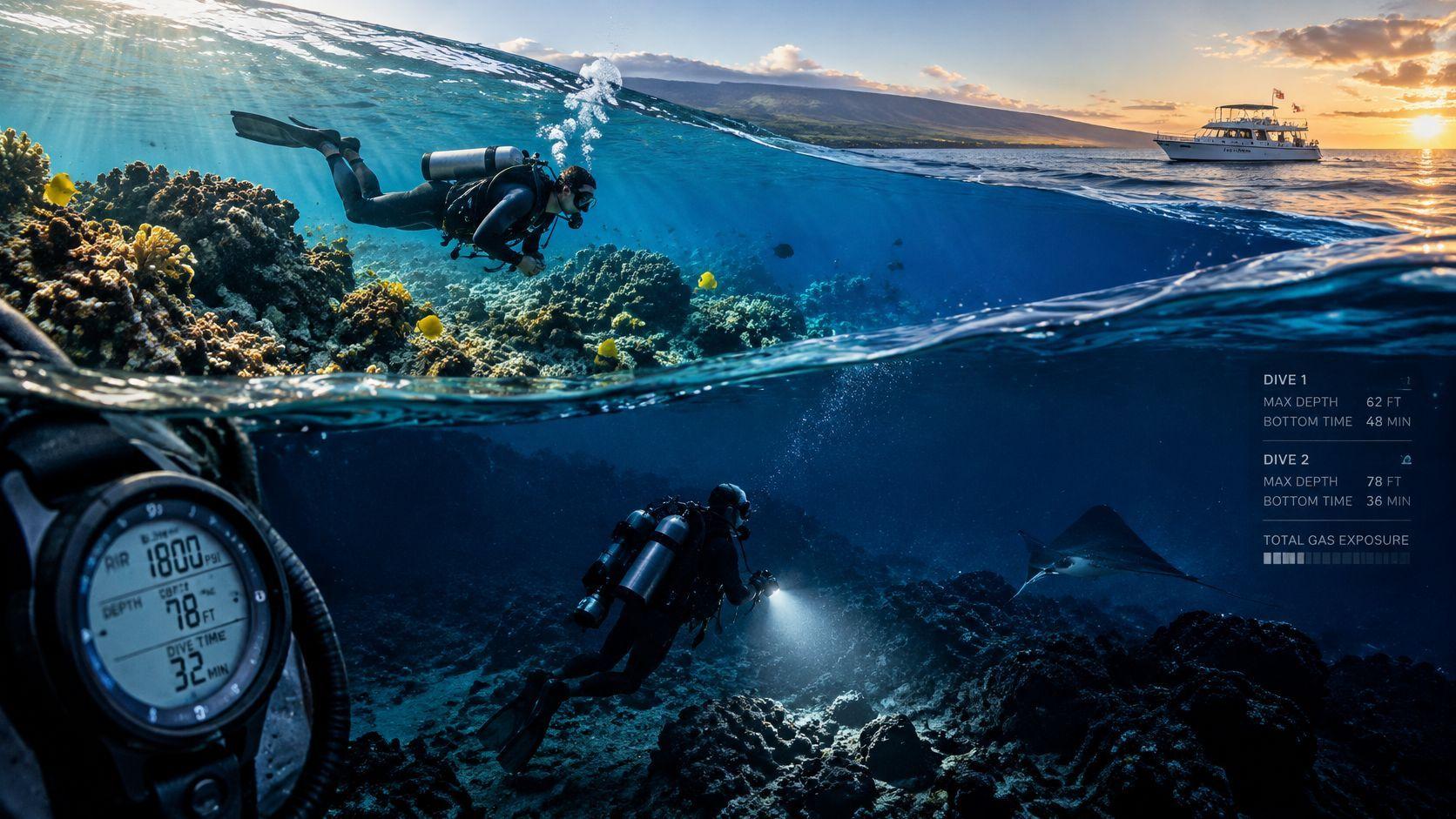
Two different problems sit inside that balance. Nitrogen narcosis is a reversible, depth-dependent impairment caused by breathing compressed inert gas, and it dulls judgment and fine motor control before you notice it happening. Decompression stress is the accumulated risk of pushing depth and time past what the plan allows, and it's controlled through depth limits, ascent procedures and no-decompression planning. The StatPearls review of nitrogen narcosis sets out both mechanisms and the practical controls that manage them.
Nitrox Is a Tool, Not a Permission Slip
Nitrox reduces nitrogen uptake relative to air at the same depth and bottom time, and that's really useful across a two-tank evening. It also raises oxygen partial pressure, which imposes a stricter maximum operating depth for the mix, because oxygen toxicity risk climbs as that pressure rises. The trade runs in both directions.
The Sequence That Keeps the Dive Boring
- Use the operator's planned depth as your reference and don't drift deeper because the sand slopes away.
- Set the mix on your computer before you splash. A computer left on air mode hands you a plan that isn't the one you're diving.
- Verify the cylinder oxygen percentage yourself with an analyzer, and write it on your slate.
- Respect the maximum operating depth for that mix. It's a ceiling, not a target.
- Dive the first one conservatively so the night dive lands inside no-decompression limits without a forced short ascent.
- Reserve gas for a controlled ascent, a safety stop and any separation or low-visibility delay.
A stationary manta dive is physically easy. You settle, you breathe, you watch. Easy isn't the same as low-gas: 45 minutes of slow breathing at depth comes out of the same cylinder as 45 minutes of swimming, and the diver who runs low is the one who leaves before the second manta arrives.
Nitrox certification qualifies you to manage gas correctly. It doesn't make deeper or longer diving automatically safer.
How to Behave During the Stationary Night Dive
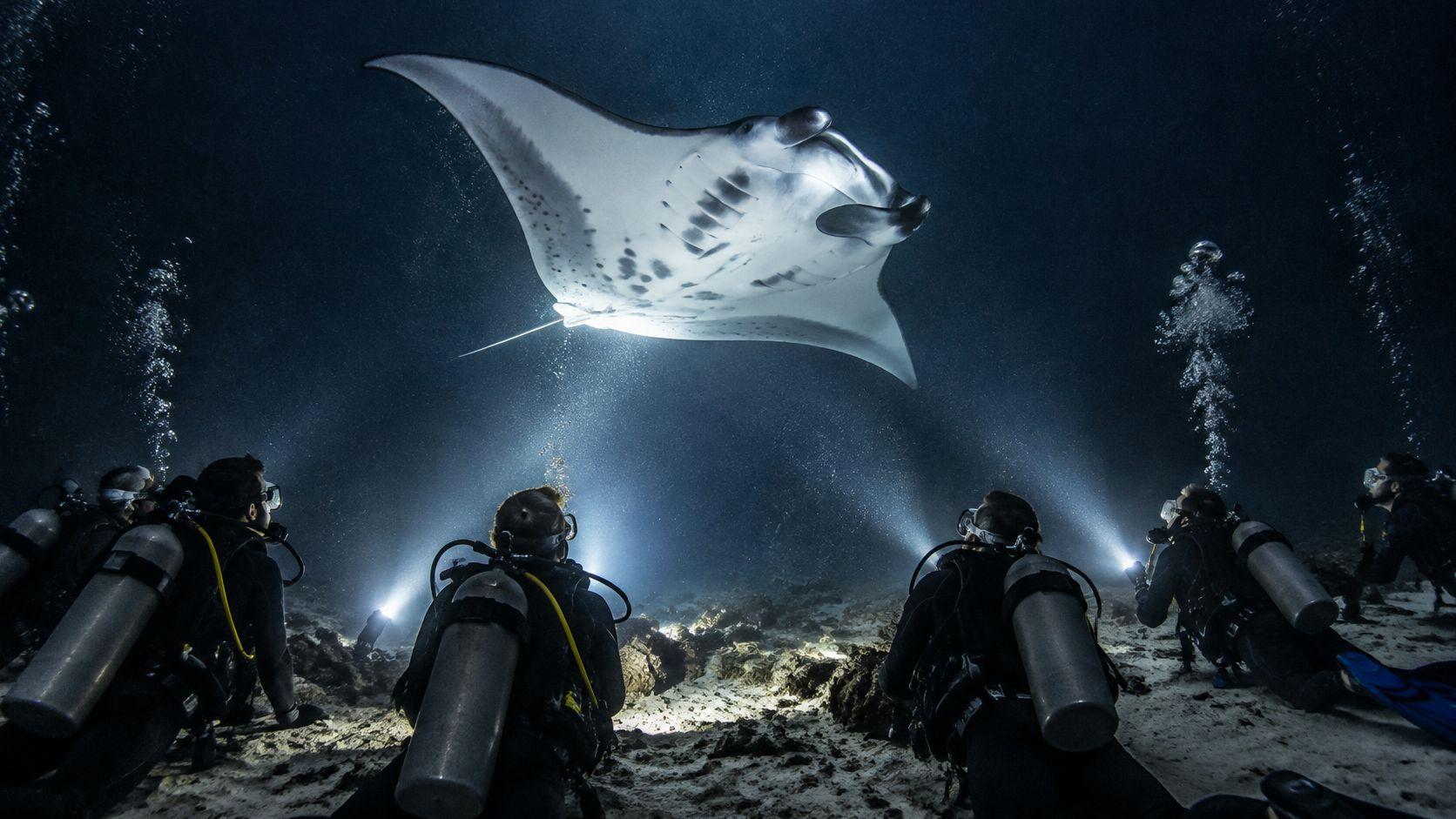
The lights are on, the plankton is building, and the first manta comes in from the dark edge of the beam, banks, and turns a slow loop above the group. What you do in the next 45 minutes decides whether it comes back.
Seven Steps, In Order
- Settle before the show starts. Choose sand, rubble or boulders, never live coral, and build a stable position with open water above you. The operator's manta dive briefing page describes a viewing position that leaves the central water column open for manta movement. A group parked on coral has already damaged the site it came to see.
- Secure everything that dangles. Console, octopus, gauge, camera, light lanyard. Loose gear snags on coral and whips around when a ray passes, and both destroy the calm that made the encounter work.
- Point your light up, never into an eye. The upward beam is what builds the plankton column. A light aimed at a manta's face blinds an animal that needs its vision to feed.
- Kick less than you think you need to. Hard fin strokes scatter the concentrated plankton and push the group out of position. Small corrections, long pauses.
- Hold the shape of the group. Stay with your assigned guide and leave the space above the group open. Rays route through that space, and a diver drifting up into it stops the traffic.
- Don't chase, touch, grab, ride or block. None of those is a grey area. Contact strips the mucus layer that protects a manta's skin from infection.
- If a manta leaves the light, do nothing. Stay put. It left because the food thinned or the traffic got heavy, and it will often circle back once the water settles.
Why the rules look strict: a still, quiet group gets more passes than an excited one, every time. The discipline is the technique.
Before the boat leaves the harbor, the crew covers manta biology, the history of Kona's rays, and how to enter, position, and return to the boat. That briefing serves as the instruction manual for the dive, and the operator-hosted guidance mirrors the voluntary NOAA viewing standard, with separate positioning expectations for scuba divers and surface snorkelers.
A good dive looks like nothing happening. A still group on the sand, quiet exhalations, lights angled upward, and a large animal taking its time overhead with room to arrive and room to leave.
Comparing Price, Included Gear and Kona Honu Divers
The headline rate on a night dive page is the least useful number on it. The two-tank Manta Ray Night Dive is priced up to $299 plus tax and fees, and the rate moves with demand, so the only figure that counts is the one quoted for your date. What that figure buys is easier to judge line by line than by comparing it to another trip's sticker.
Criterion — What to check — Why it matters
Price basis — Base rate, tax and fees, and any demand-based changes — An old quote tells you nothing about your date
Included gear — Tanks, weights, dive light and Nitrox status — Included equipment is gear you won't pay for twice
Guide ratio — Number of divers per guide on the night portion — Fewer divers per guide means closer supervision in the dark
Sighting policy — Stated sighting rate and the fallback dive — Wildlife trips carry no guarantee, so the backup plan is part of the product
Cancellation — Notice period for changes or rebooking — Weather and sunset times can shift a trip date
Private charter — Whether a private group trip is offered — Suits families and groups that want the boat to themselves
An Operator Worth Reading Closely
The Manta Ray Night Dive is run by Kona Honu Divers aboard Honu One, departing Honokohau Harbor and cruising north along the coast to Garden Eel Cove. Kona Honu Divers has offered the Hawaii manta ray night dive since 2002, and the Kona Honu Divers trip details show how the evening is assembled: a late-afternoon reef dive among lava tubes and Hawaiian reef fish, a sunset surface interval with a meal, a briefing on manta biology and positioning, and a stationary observation dive of approximately 45 minutes on the seafloor.
The trip is divers only. Certified divers aged 16 and up can book, and anyone under 18 must dive with a parent or guardian. Snorkelers don't ride along on this boat; they book the separate Manta Ray Night Snorkel, a guided surface viewing trip run with a lifeguard-certified crew.
On inclusions, the two-tank trip comes with free Nitrox and both tanks, and hot showers wait on board for the ride back. Those line items matter more than a discounted rate, because they are the equipment and comfort you would otherwise pay for separately.
The Rule Before You Pay
Score the trip against the six rows using the booking page for your date, not a review from another season. Then ask three questions in writing: how the sighting rate is measured, what the fallback dive is on a no-manta night, and whether that quiet night costs anything. A crew that answers plainly is telling you how they handle the hundred other calls a dark reef demands.
Confirm Your Booking and Check-In Details
Six actions, in order, and the trip is settled.
- Read the current rate on the booking page, including tax and fees. Rates move with demand, and advertised individual pricing reaches $299 before those add-ons, so a price quoted in an old review is decoration.
- Match the departure window to your calendar for that date, then apply the age rule cleanly: certified divers aged 16 and up, with any diver under 18 accompanied by a parent or guardian.
- Ask about the sighting policy in writing. You want the fallback dive described in plain terms.
- Ask about cancellation and rebooking before you pay, especially if your manta night falls at the end of your trip.
- Read the confirmation email twice. It carries the exact Honokohau Small Boat Harbor check-in spot and time, which matter more than the harbor name alone.
- Pack for the return leg. Certification card, any medical note that applies to you, and a dry layer for a cool, wet ride back.
Call 808-315-7114 with questions about eligibility, included gear or check-in timing; the office is at 74-5583 Luhia St A20, Kailua Kona, HI 96740. If you want the full trip structure before deciding, the Manta Ray Night Dive trip overview lays out the timeline, included equipment and guiding ratio.
Book the two-tank night dive if you meet the eligibility rules and can tick the readiness list. If you cannot, book a daytime reef dive, rebuild your hovering and air discipline, and come for the mantas on a later trip. These animals are resident. They will still be there.