
Manta Ray Night Dive Kailua Kona: What to Expect
Plan your Manta Ray Night Dive Kailua Kona trip: two-tank itinerary, eligibility, safety rules, sighting odds and how to choose a certified operator.
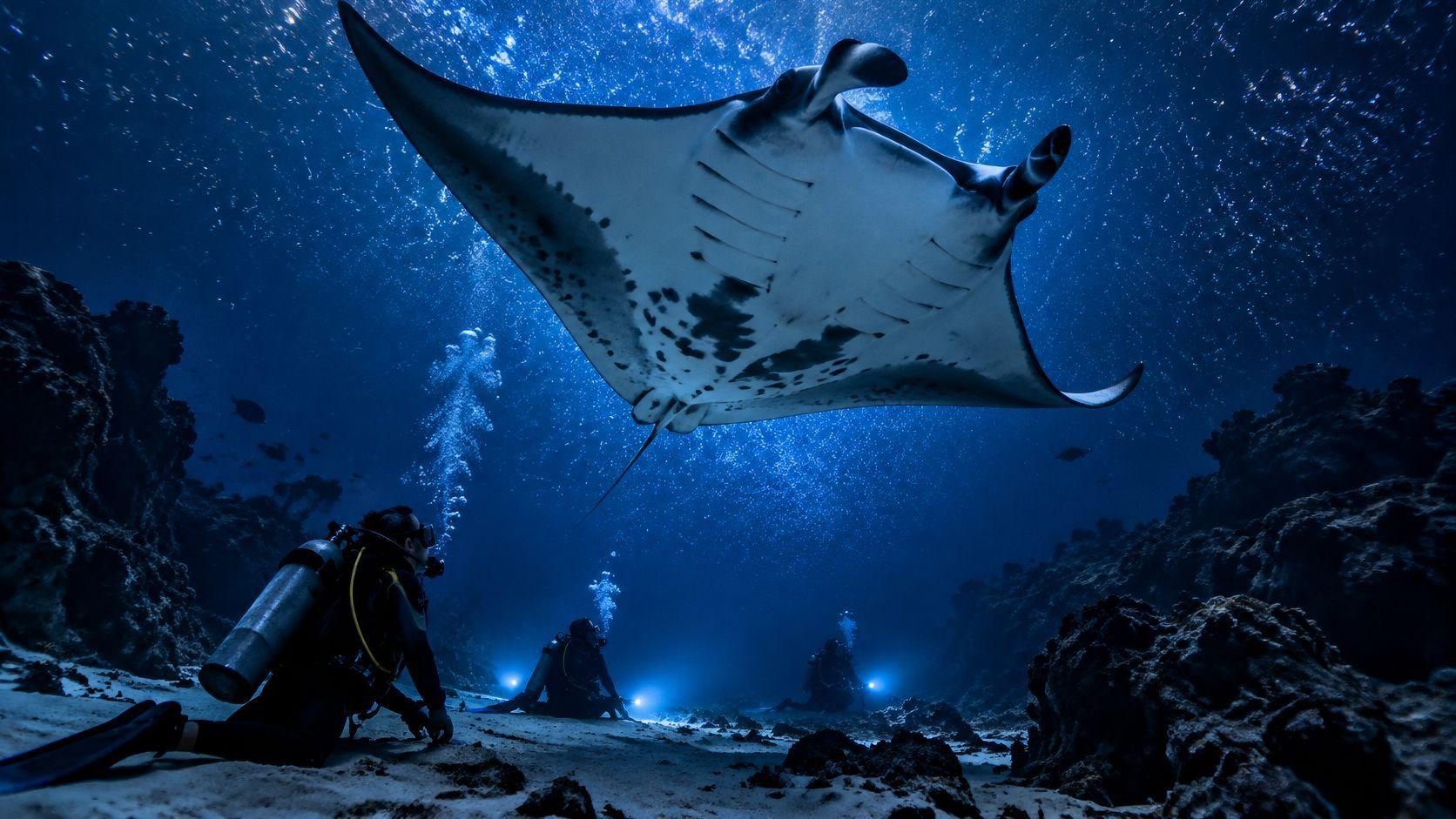
You've got one night left in Kailua-Kona, three manta tour tabs open on your phone, and the same photograph on all of them: a ray a foot from somebody's mask. The photos leave out the ten minutes before that moment, when you're kneeling on sand in black water, listening to your own breathing and waiting to find out whether tonight is one of the good ones.
That wait is part of the trip. A manta ray night dive in Kailua Kona is a wild feeding event built on a food chain, not a show with a start time. You can raise your odds, read an operator before you pay, and be ready in the water. You can't order the rays.
What follows is the evening in the order you'll live it: who's allowed in the water, how the five hours run, the safety controls worth confirming at the briefing, honest numbers on sightings, boarding logistics for divers who need them, and the questions that separate a well-run boat from a crowded one.
Table of Contents
- Who Can Join and What to Bring
- How the Two-Tank Manta Night Dive Unfolds
- Safety Rules That Protect You on the Night Dive
- Sighting Odds and What Mantas Do at Garden Eel Cove
- Boarding, Access and Getting to the Harbor
- Responsible Viewing and the Open Sustainability Question
- Comparing Operators and Booking Your Night
Who Can Join and What to Bring
The night dive is a scuba trip, and snorkelers are not taken on it. Anyone who wants to watch mantas from the surface needs a separate snorkel tour, which runs on a different format with a different crew brief. That single rule settles most of the questions people ask at the dock.
For divers, the requirements are modest but not optional. You need Open Water certification or higher, at least one logged dive within the previous two years, and current medical fitness with no heart conditions. A stationary dive over sand is forgiving of rusty skills. It is not forgiving of an untreated cardiac issue or a long gap in the water.
Diver type — Certification or age — Extra condition — Booking step
Certified adult diver — Open Water or higher — Dived within the previous two years; good health, no heart conditions — Confirm recent diving and fitness before paying
Certified junior diver — Open Water or higher, under 18 — Parent or guardian on the trip — Call ahead; a private guide is arranged by phone for younger juniors
Non-diver or snorkeler — Not eligible for the night dive — Dive trip only — Look for a separate snorkel option
A few tiers need a phone call rather than a click. Divers aged 16 and up can book. A certified diver under 18 joins with a parent or guardian on the trip. Families with a younger certified junior should call before booking, because junior bookings run on separate rules and a private guide is arranged by phone in advance. The pre-dive briefing is delivered in English, so every diver needs to follow it without translation.
What to Bring and What's Already on the Boat
- Certification card and logbook. The logbook is what proves you've dived recently. A card alone doesn't.
- A completed medical self-assessment. Answer it truthfully. A "yes" on the heart questions sends you to a doctor, not into the water.
- Swimwear plus a warm layer. The boat cools fast once the sun drops, and you'll sit damp through the surface interval.
- Your own mask if it fits well. Ill-fitting rental masks are the most common reason people spend a dive clearing water instead of watching rays.
- Tanks, weights and a dive light. Most Kona boats fold these into the fare. Confirm what yours covers so you aren't carrying lead you don't need.
Send the operator your certification level and the date of your last dive in writing before you pay. A gap in recent diving is easy to solve by email in advance and awkward to solve at the dock.
How the Two-Tank Manta Night Dive Unfolds
Most first-timers arrive with gear questions. The better question is what the evening asks of you at each stage, because the manta half only works if the first half ran calmly.
The trip runs about five hours from Honokohau Small Boat Harbor, where you meet the crew for a briefing on manta biology and the history of Kona's rays. Departures fall between 2:45 and 4:00 p.m., shifting with sunset, and the boat is back at the dock between 7:45 and 9:00 p.m.
That history goes back further than the marketing suggests. University of Hawaiʻi research records local operators taking scuba divers and snorkelers to manta sites near Keauhou Bay, Hoʻona Bay and Makako Bay since at least the mid-1980s, and by 2004 the Manta Pacific Research Foundation estimated that 10,000 to 12,000 scuba divers visited the principal Kona manta site each year (University of Hawaiʻi research). This isn't a novelty invented by online booking.
Stage — Timing — What Happens — What You Do
Check-in and briefing — From 2:45 p.m. — Crew meets guests at Honokohau Small Boat Harbor for a manta biology briefing — Arrive early and confirm your check-in spot
First dive — Late afternoon — Reef dive among lava tubes and Hawaiian reef fish — Stay with your guide and keep buoyancy steady
Surface break — Between dives — Light meal and briefing on manta behavior and feeding — Review the night plan and signals
Second dive — After dark, about 45 minutes — Settle on sand around underwater lights to watch feeding mantas — Hold a stationary position and keep lights off the flight path
Return — Between 7:45 and 9:00 p.m. — Boat returns to the harbor — Rinse gear and check belongings before leaving
Where the Plan Can Change
Sunset is the variable that moves everything else. In winter the light goes early and the sequence shifts forward; in summer the same itinerary runs later. Match the published departure window against the sunset time for your date and you'll know whether you're eating on the boat in daylight or in the dark.
The second variable is the animals. If no mantas appear, the second dive becomes a night reef dive at the same site with the same guide, which is a real dive rather than a consolation prize. Plan for that and you won't spend the surface interval staring at the water.
The third is you. The late-afternoon reef dive is where you knock the rust off: weighting, trim, mask clearing, finning without stirring sand. Treat it as a rehearsal. By the time the lights go down you want your only task to be holding still.
Safety Rules That Protect You on the Night Dive
Safety on this dive is mostly about being predictable. You aren't navigating a reef in the dark or hunting for animals. You hold a position over sand while large rays run feeding passes above you, and the crew's job is keeping a whole group doing that in one place at one time.
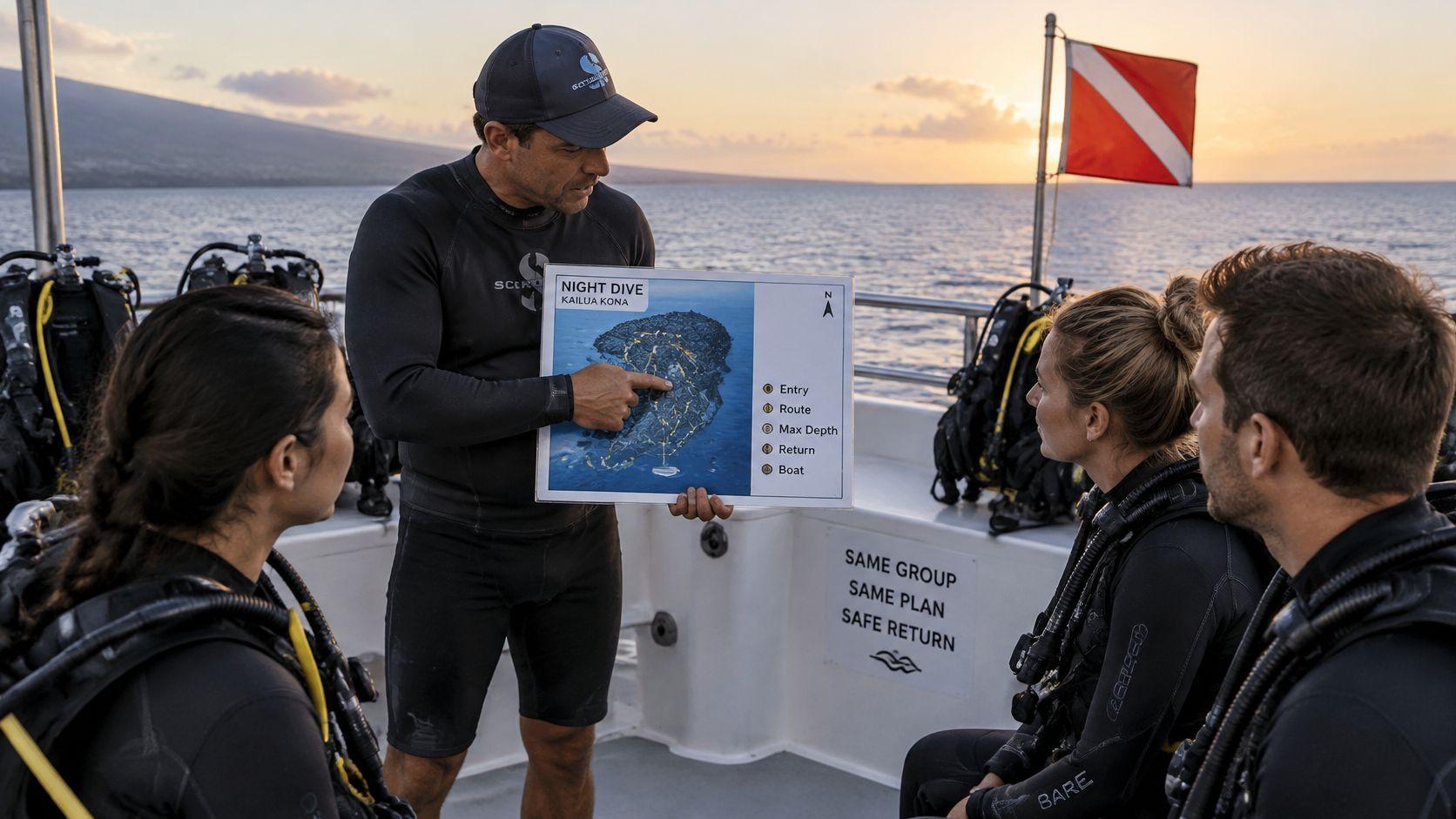
The regulatory floor is simple. Hawaiʻi's Division of Boating and Ocean Recreation states that a dive flag used at night must be illuminated and visible from 100 feet (Hawaiʻi Division of Boating and Ocean Recreation). The rule exists because darkness shrinks the distance at which a boat crew can recognize a diver's position, so a lit marker gives an approaching vessel something to identify before it enters the operating area.
The Six Checks Before You Back-Roll
- Who controls the group's position. Ask who places divers and who leads the return. A group that drifts apart in the dark is the main failure mode, and a fixed observation point prevents most of it.
- Where the illuminated flag is. You should be able to point to it from the surface. If you can't, neither can a boat driver.
- Your light is tethered. A wrist lanyard or bolt snap keeps the torch on you if your hand comes off it. Loose lights end up on the sand.
- Your beam stays low. Use it for gauges the sand and signals. Beams aimed up into the water column flatten the contrast that makes the plankton zone visible, and a beam in a ray's eyes ends the pass.
- You hold one position. Stay at the edge of the lit water rather than swimming through it. Motion splits the group and interrupts feeding runs.
- The recall signal and lost-diver procedure. Confirm both in daylight, not at 40 feet in the dark. Low visibility is the whole reason the procedure exists.
Practical rule: if you can't repeat the recall signal and the lost-diver procedure in one sentence each, ask again before you back-roll.
Keep your body, gauges and fins clear of the rays' flight path, and never touch or chase them. None of this replaces certification, gas planning, recent experience or an honest medical form. It sits on top of them. For the full sequence from check-in to ladder, our manta ray tour briefing walkthrough covers how the evening is run.
Sighting Odds and What Mantas Do at Garden Eel Cove
Every boat in Kona sells the same promise, and none of them can keep it on demand. The ray in the photograph is a wild animal responding to food, current and light. The honest way to plan is around probability, not certainty.
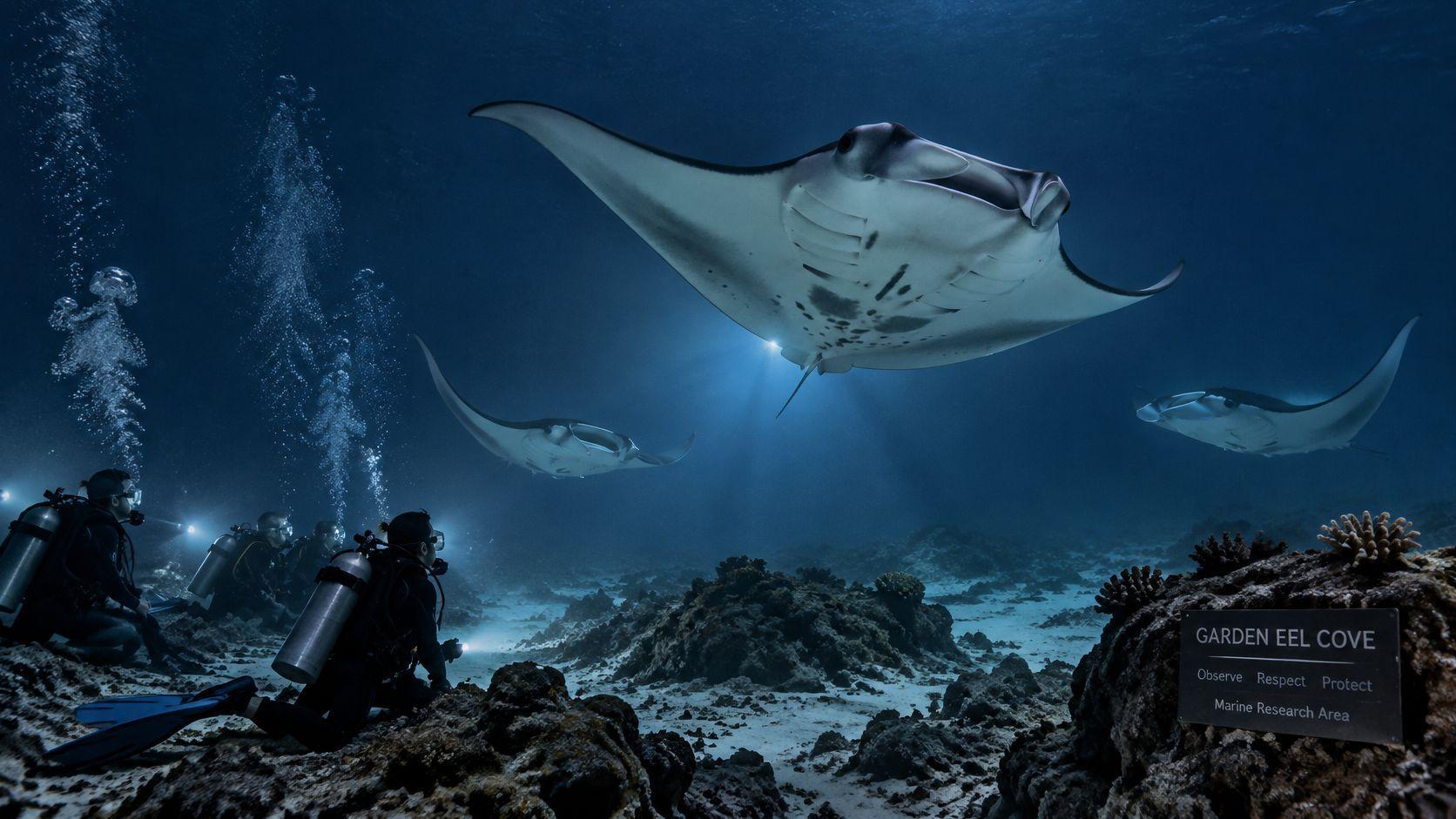
The longest dataset available makes the point better than any brochure. A 13-year University of Hawaiʻi analysis documented 23,106 reef manta sightings from 2,890 identification reports at Garden Eel Cove and Keauhou between January 1, 2010 and December 29, 2022, covering 167 individually identified rays (University of Hawaiʻi manta aggregation study). That many records confirm the rays use these sites after dark routinely. They also confirm that no single evening is average.
Site — Typical evening — Sex composition
Garden Eel Cove — 8.89 mantas on average, median 7, with recorded nights from 0 to 45 — Balanced
Keauhou — Smaller, steadier groups — 91% female
The two sites sit a fair distance apart along the Kona coast, and the difference matters when you're choosing a trip. Garden Eel Cove produced the larger and more variable groups, including one recorded evening with 45 rays and others with none at all. The same dataset tied aggregation size to zooplankton density, which means prey availability drives attendance more than the lights alone. A quiet night usually reflects the food, not the crew.
Why the Lights Work and What You're Actually Watching
Manta rays feed by funneling prey. NOAA Fisheries identifies euphausiids, copepods, mysids, decapod larvae and shrimp as primary prey, and describes how the rays use their cephalic fins to form a funnel, open their mouths and retain food on gill rakers while filtered water exits (NOAA Fisheries giant manta ray management). The same source links visitation timing to zooplankton movement, currents, tides, seasonal upwelling and temperature, so the evening's attendance starts moving before the boat ever leaves the harbor.
That explains the barrel rolls and the feeding chains. A close approach is usually a filtration trajectory along the plankton line, and holding still at the edge of the beam puts you in position for the same pass to repeat.
A high sighting rate is not the same thing as a guarantee, and a quiet night is not a failed trip. Judge the evening on the briefing, the positioning and the reef dive.
For scale on what a good night looks like, mantas are seen on about 80% of manta ray night dives, which leaves a real share of evenings where the second dive becomes a night reef dive instead. I'd treat that reef dive as part of the product you paid for rather than a write-off. No crew can schedule the alternative, and the honest ones will say so before you board.
Boarding, Access and Getting to the Harbor
The hardest part of the night for some divers isn't the water. It's the step from the pier onto a moving deck in the dark, wearing a cylinder.
Walk the route before you book it: across the dock, over the gap onto the vessel, a spot to kit up, then a ladder or platform on the way out. Each transition has a different difficulty, and "accessible" as a single label tells you nothing about which one will stop you. The Open Travel Guide flags pier-to-vessel transfer as potentially difficult for travellers with lower-body mobility limitations and advises confirming suitability in advance (Open Travel Guide).
Put four questions in writing before you pay:
- How is the boarding step managed? Ask where the transfer points are and whether there's a stable handhold at each one.
- What does the exit ladder look like? Ladder rungs, a platform, or a stern step all demand different upper-body work with a tank on.
- Can crew or my buddy assist with gear and transfers? Get an answer about who physically helps, not just that help exists.
- What can't the boat accommodate? Ask about prostheses, limited range of motion and equipment you plan to bring.
Then the ordinary logistics. Trips leave from Honokohau Small Boat Harbor in Kailua-Kona, and the confirmation email carries the exact check-in spot and time, so read it rather than guessing at the dock. Sunset sets the return, which means the parking lot fills early and the boat won't wait.
Keep scuba requirements separate from snorkel arrangements. The dive has certification conditions; a surface tour doesn't. Ask about the one you're booking.
Responsible Viewing and the Open Sustainability Question
Experienced divers tend to ask a harder question than whether mantas are dangerous: does concentrating them under lights, night after night, change how they feed? Researchers generally recommend a precautionary approach to manta tourism, because the long-term effects of frequent night encounters on manta populations have not been measured.
What is established is narrower. More boats and guests visit Kona's viewing sites each year, formal rules for the encounters remain thin, and no broad manta population decline has been documented. Both halves matter. A strong sighting rate doesn't prove the practice is ecologically neutral, and claims of collapse aren't supported either.
A busy light field proves the rays are feeding. It doesn't prove the practice is neutral.
Your lever is operator choice, because the number of boats converging on one light field each night decides how much pressure those rays absorb. Look for stated group limits on divers per boat and divers per guide. Watch whether lights stay brief and off the animals' faces. Ask whether a guide can end a dive early if mantas show avoidance. Ask whether the operation shares sighting reports with researchers, which is how the long-term record gets built in the first place.
A crew that answers those questions directly is telling you it manages the site. A crew that can't is telling you something else.
Comparing Operators and Booking Your Night
Price is the easiest thing to compare between Kona operators and the least useful. Two boats can visit the same site on the same evening and deliver completely different experiences, because most of what you pay for is how a crew manages people in the dark.
Run this trip through the same checks you'd apply to any operator. Manta Ray Night Dive is operated by Kona Honu Divers, a PADI Five Star operator running Hawaii manta night dives since 2002, aboard the Honu One out of Honokohau Harbor. The five-hour excursion pairs a late-afternoon reef dive with the manta dive at Garden Eel Cove, so the night encounter is the second half of a structured progression rather than a standalone dash. The trip is capped at 18 divers with one guide for every six, the boat carries a hot shower and marine toilet, and departures shift between 2:45 and 4:00 p.m. to follow sunset.
Six criteria worth testing, here and anywhere else:
- Credentials and training standard. A five-star rating is a starting point, not proof. Ask what training the in-water guides hold.
- Guide-to-diver ratio, in writing. One guide per six divers is the number that decides how closely anyone watches you after dark.
- Briefing content. Manta behavior, emergency signals, lost-diver plan. If the brief is all enthusiasm and no procedure, that's your answer.
- Boat size, facilities and boarding access. A hot shower and a marine toilet matter more than you think after a night dive.
- Sighting policy. Ask what the second dive becomes when no rays appear. On this trip it converts to a night reef dive.
- Cancellation and rebooking terms. Weather decides more departures than calendars do, so know the cut-off.
This trip takes certified divers only, with snorkelers carried on a separate boat, and it's priced up to $299 plus tax and fees with prices varying by demand. Cancellations or rebooking are allowed until 72 hours before departure. Current times and availability sit on the two-tank manta dive booking page, and certification or boarding questions go to 808-315-7114.
Settle three things before you pay: your certification level and last dive date (Open Water or higher, with a dive inside the previous two years), the departure window against sunset for your date, and the boarding and cancellation terms in writing.
Manta Ray Night Dive runs the evening to a plan: briefing, sunset meal, a guided night dive, and Nitrox included for certified divers at no extra cost. If this trip is on your Kailua-Kona list, check the sunset-based departure window for your dates and reserve a seat.