
Kona Hawaii Manta Ray Night Dive: What to Expect in 2026
Plan a Kona Hawaii Manta Ray Night Dive: two tanks, sunset meal, eligibility, inclusions, safety standards and how to book a guided trip.
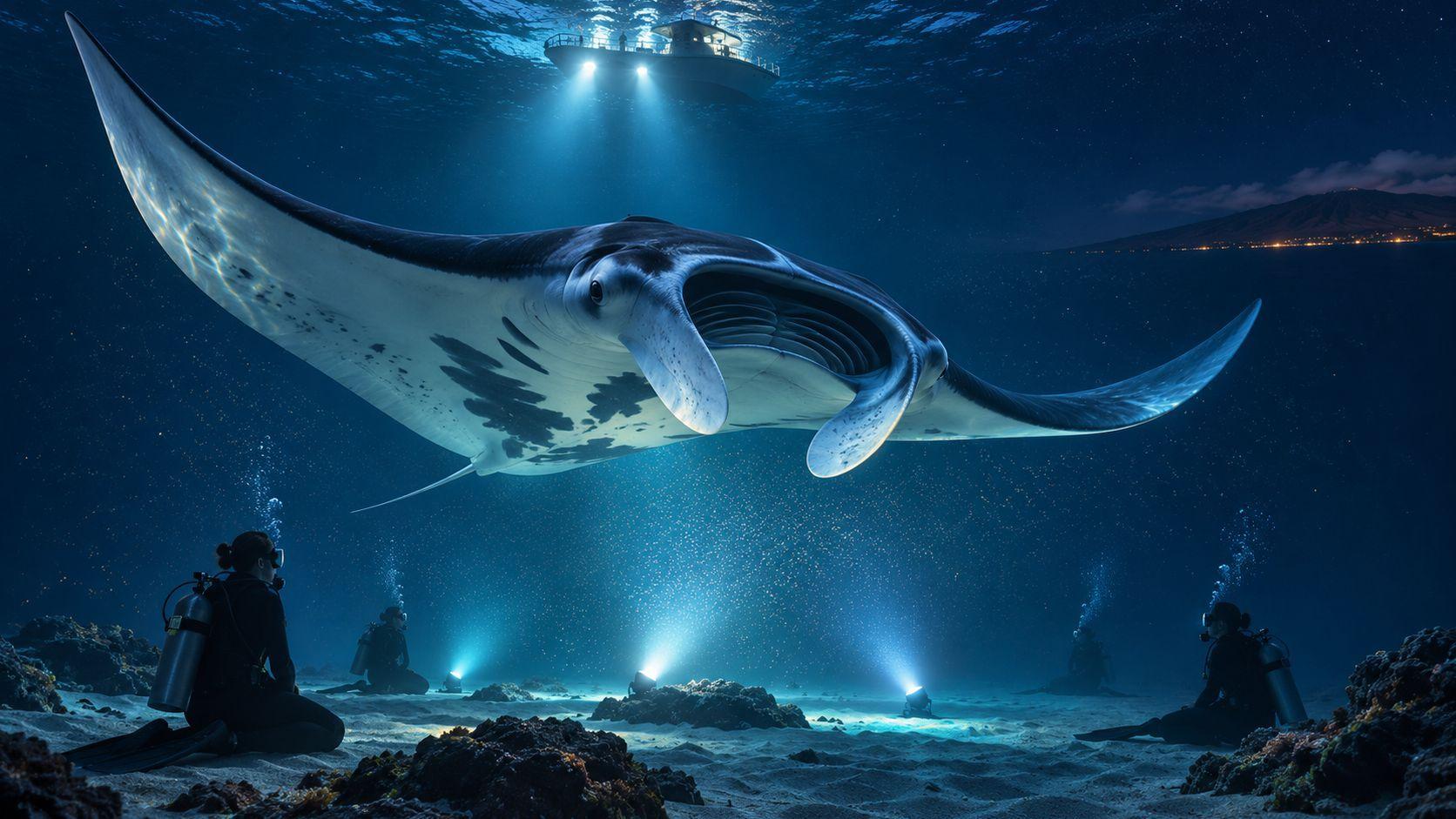
You've got a booking page open, your certification card somewhere in your luggage, and a free evening in Kona. The photos show manta rays banking above divers' heads, but they don't answer the questions that matter once you're standing on a boat in a damp wetsuit. How much diving experience do you need? What happens if the rays don't arrive? Who's watching the boat traffic while you're underwater?
A Kona, Hawaii manta ray night dive is best planned as a whole evening, not a guaranteed wildlife photograph. Look for an unhurried reef dive, a useful briefing, controlled underwater positioning, and a clear fallback. The mantas choose whether to appear. You choose who takes you out.
Table of Contents
- Who Can Join and What Certification You Need
- What Is Included and What to Bring
- The Two-Tank Night Dive From Start to Finish
- How the Night Dive Works at Garden Eel Cove
- What Happens When Mantas Do Not Appear
- Safety and Impact Standards to Check Before You Book
- Choosing Your Operator and Booking the Night Dive
Who Can Join and What Certification You Need
Our eligibility standard is Open Water certification or higher, with a dive within the previous two years. Start there, before choosing a date or picturing the encounter.
Recent experience matters because darkness adds tasks to familiar skills. You'll need to find your inflator without looking, read your gauges under a light, and communicate without lifting your head to speak. Those actions should feel familiar before you enter dark water from a boat.
Check your readiness before booking
Ask yourself these questions with complete candor:
- When did I last dive? Check your logbook rather than guessing. If your equipment skills feel rusty, arrange a refresher before the excursion.
- What does my certification card say? Have your card or digital record ready, including any additional qualification you intend to use.
- Do I have a heart, health, or breathing concern? Discuss anything that could affect diving fitness with a doctor familiar with diving medicine, and confirm the operator's medical-clearance requirements.
Say you're comfortably within the recency window, but your last dive involved a borrowed regulator and help with every buoyancy adjustment. Mention that before paying. Meeting an eligibility rule and feeling ready aren't always the same thing.
Readiness check: You should be able to manage your equipment while paying attention to your buddy and guide, not spend the dive relearning where everything is.
Plan for your whole party
Nitrox requires the appropriate certification. If you don't hold it, plan to dive on air; the manta encounter isn't a reason to use an unfamiliar breathing gas.
Our Manta Ray Night Dive is for ages 16 and up, and divers under 18 must be accompanied by a parent or guardian. It's a divers-only excursion, so snorkelers need a separate outing rather than a place aboard this dive.
Before booking, settle any medical paperwork and language needs. Don't assume a translated briefing will be available. Everyone needs to understand the entry instructions, underwater signals, and exit procedure without relying on hurried interpretation at the ladder.
What Is Included and What to Bring
The Kona Honu Divers guided-trip listing includes two tanks, weights, a dive light, and a guide, with air or free Nitrox for appropriately certified divers. Use that core package to organize your gear, but don't mistake it for a promise that every personal item is supplied.
Included items and what you still bring
Item — Status — Detail
Two tanks — Included — Air, or free Nitrox for certified divers
Weights — Included — Supplied with the package
Dive light — Included — Used during the night dive
Guide — Included — Supervises the dive; confirm the group ratio
Light meal — Included — Served between the two dives
Personal mask, fins, snorkel and wetsuit — Not listed — Confirm with the operator before the trip
A bundled booking reduces separate rental arrangements. You aren't trying to collect weights from one shop and a light from another while watching the departure clock. The meal also fits into the surface interval, when you can get out of your gear, eat, and watch the shoreline change in the sunset.
Resolve the personal gear details
Lay your equipment out before packing it. Check mask straps, fin buckles, regulator condition, and computer battery status, then separate wet gear from the dry clothes you'll want afterward.
Bring a towel and a warm layer for the return ride. A sweatshirt in a dry bag is more useful than one tucked beneath a dripping wetsuit.
Ask these questions before departure:
- Personal equipment: Which items are supplied, which are rentals, and which must you bring?
- Nitrox availability: Are fills available for your departure, and what certification record will staff check?
- Equipment failure: What happens if your regulator, computer, or light fails during the trip?
That last answer matters. You want to know the replacement or missed-dive procedure before you discover a problem offshore.
The Two-Tank Night Dive From Start to Finish
Say you arrive at Honokohau Small Boat Harbor with your certification ready and your harbor directions saved offline. Use the exact meeting spot and check-in time in your confirmation, not the first boat you see with dive tanks aboard. Our evening begins with the crew's educational briefing about manta biology and the history of Kona's rays.
The Kona Honu Divers tour page describes a roughly five-hour, two-tank excursion, departing between 2:45 and 4:00 p.m. and returning between 7:45 and 9:00 p.m., with manta viewing generally around 35 feet, or 10 meters, in calm conditions.
Two-tank manta night dive timeline
Time — Stage — What Happens
2:45–4:00 p.m. — Departure — Boat leaves Honokohau Harbor aboard Honu One
Late afternoon — First dive — Guided reef dive among lava tubes and reef fish
After the first dive — Surface interval — Light meal, sunset views and manta briefing
After dark — Second dive — About 45 minutes at Garden Eel Cove, around 35 feet
7:45–9:00 p.m. — Return — Boat docks back at the harbor, timed to sunset
Honu One carries the trip north along the Kona coastline toward Garden Eel Cove. During the late-afternoon reef dive, low-angle light reaches across volcanic formations while Hawaiian reef fish move around the rock. Lava tubes add texture to the route, but don't assume the plan includes entering overhead spaces.
This first dive also gives you a practical equipment check. A mask that leaks or a weight arrangement that feels awkward is easier to discuss while there's still daylight.
From sunset to the return dock
Back aboard, you have a light meal and a surface interval before the manta briefing. Listen for where you'll settle, how the guide will get your attention, and what to do if you need to leave the viewing area.
The manta ray tour overview can help you picture the format before departure. On the boat, though, the crew's instructions govern the actual entry and conditions.
After the night dive, dry off before you get chilled. Keep dry clothes accessible, decide who's driving, and leave room in your evening for a tired, salt-haired return rather than a rushed dinner reservation.
How the Night Dive Works at Garden Eel Cove
Underwater lights gather plankton into an illuminated patch of water. Reef manta rays feed by filtering that prey-rich water, making repeated passes when feeding conditions suit them. They're coming for food, not for the divers.
The photograph shows the position you're aiming for: low, settled, and out of the animals' route.
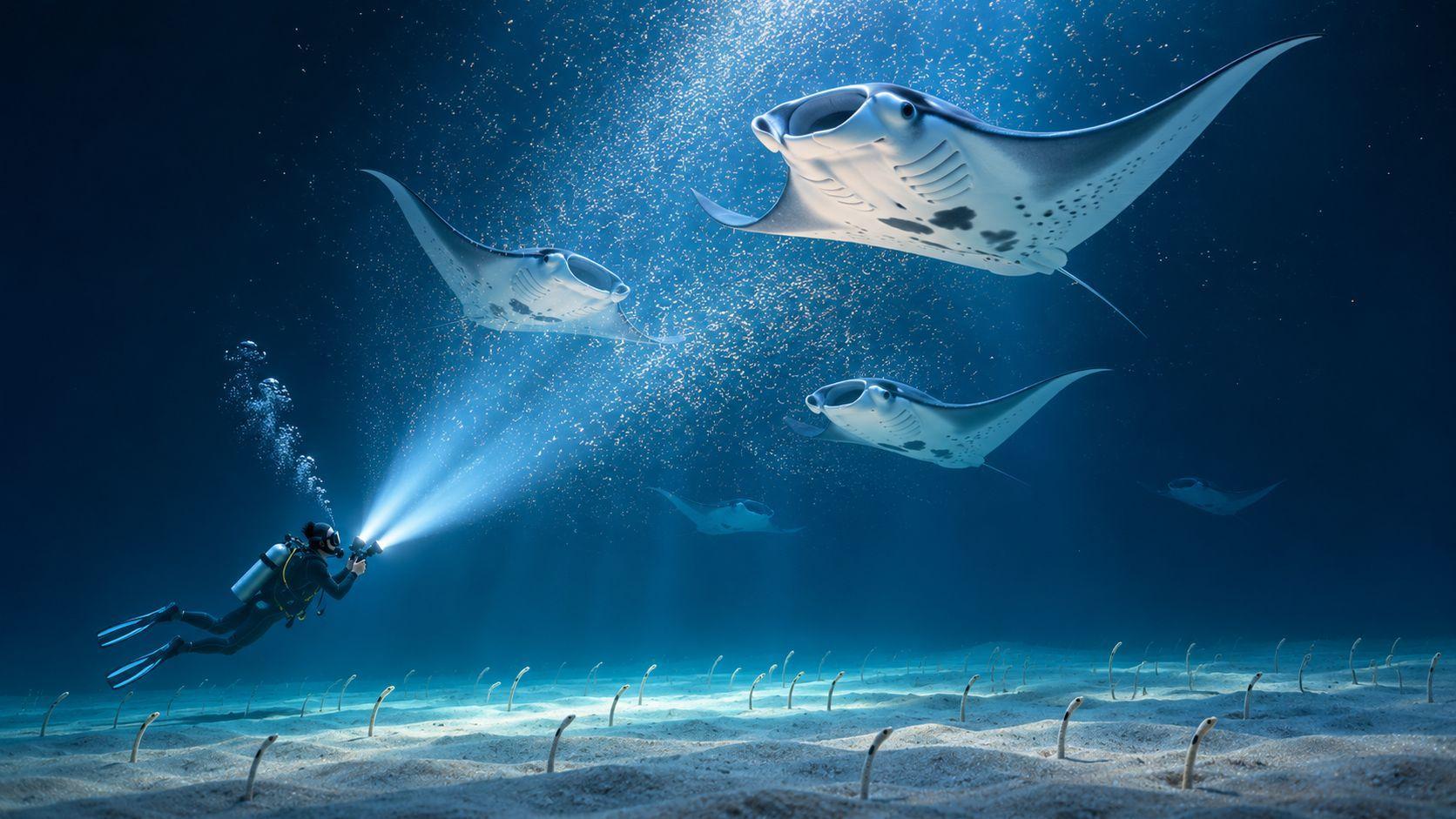
Think of the light as the stage, the plankton as the show, and the divers as the audience. Nobody improves the performance by climbing into the middle of it.
Garden Eel Cove and Keauhou are the principal nighttime aggregation sites on this coast, approximately 20 km apart, as described in the Kona manta observation document hosted by NOAA. The Garden Eel Cove guide provides useful site context, but your guide selects your actual position.
Your underwater procedure
The Kona Honu Divers viewing procedure emphasizes a stable formation and passive observation rather than pursuit. Put that into practice in this order:
- Learn the signals. Listen to the briefing, including how to report a problem and request help.
- Enter and settle as directed. Use the designated sand, rubble, or boulder area. Don't choose living coral as a resting place.
- Secure loose equipment. Keep fins, hoses, snorkels, and cameras controlled so nothing projects into the feeding route.
- Breathe normally and stay low. Don't hold your breath while watching a close pass. Keep checking your gas and computer.
- Let the mantas approach. If a ray turns away, remain where you are rather than following it.
- Use the agreed light position. Aim only where the guide directs, never into a ray's face.
- Keep the route open. Don't touch, chase, grab, ride, or block a manta.
When a ray comes close
A broad silhouette may appear beyond the beams, turn, and reveal its pale underside as it passes overhead. That's when people are tempted to lift a camera, straighten their legs, or reach upward. Keep your profile compact and let the animal finish its pass.
Watch the feeding movements in this video, especially the room the rays need to turn.
Your best viewing position is one you can hold without obstructing the animal beside or above you.
Staying still preserves the formation. A diver swimming through the feeding zone can interrupt another person's view, create an equipment conflict, and occupy the space a manta needs to maneuver.
What Happens When Mantas Do Not Appear
Say you settle onto the sand at Garden Eel Cove, the lights come up, the plankton gathers in the beams, and after a full dive no broad silhouette has crossed overhead. That outcome is possible on any given trip. Manta appearances vary with conditions, and no departure carries a guaranteed sighting.
Even when rays do show, a sighting isn't a uniform experience. You might get a brief pass at the edge of the lights, several animals returning repeatedly, or a larger aggregation that keeps everyone looking upward. Visibility and usable bottom time shape the evening too.
The reported sighting rate is 80% of manta ray night dives. That figure describes past encounters across many trips, not a promise attached to yours.
Choosing a date is not choosing conditions
You can reserve a calendar slot, but you can't reserve the plankton concentration that draws mantas to feed in numbers. Ask the operator which months they find reliable, then weigh that answer against weather flexibility and the sunset schedule. A favorable month means better odds, nothing more.
Know what replaces the headline encounter
If mantas don't appear, the second dive becomes a night reef dive. Your light may pick out reef fish tucked into shelter, an eel near a crevice, or small invertebrates against the rock. Those are possibilities on the reef, not a substitute list of guaranteed animals.
It is still a dive you paid for and logged. It is a different experience from the one pictured on the booking page, and judging the trip means holding both facts at once.
Plan for disappointment before departure: A worthwhile fallback can soften a missed encounter, but it shouldn't be used to disguise what didn't happen.
Three moves reduce the risk of a frustrating evening:
- Get the fallback in writing. Confirm what happens underwater if mantas stay away and whether any return-trip offer applies. Don't assume a free rebooking.
- Choose a flexible date. Book early enough in your stay to leave room for a weather change or another available departure.
- Protect another evening. If mantas are central to your holiday, keep space for a second attempt without assuming availability.
Approach the booking as a strong night dive with a possible manta encounter. That leaves room for excitement without making the animals responsible for your entire vacation.
Safety and Impact Standards to Check Before You Book
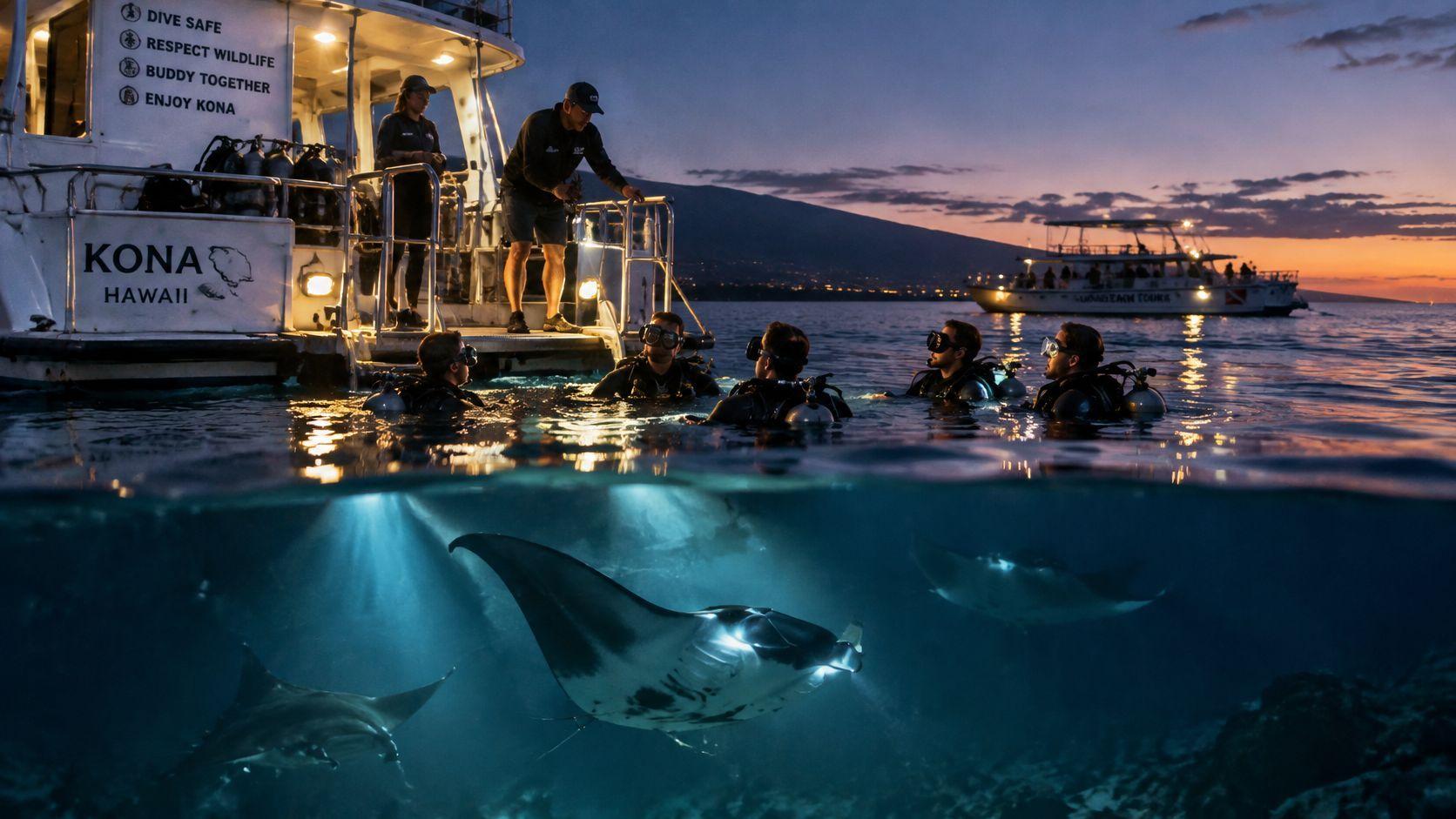
Mantas returning to Kona's illuminated sites doesn't make every boat movement or viewing arrangement safe. Darkness concentrates swimmers, submerged divers, vessels, and bright lights in the same area. Someone needs to manage those interactions throughout the dive.
SFGATE's reporting on Kona manta tours describes vessels traveling too fast, boats passing within 10–20 feet of unlit snorkelers, and boats passing over submerged divers, alongside visibility problems caused by darkness and glare.
The surface operation deserves as much scrutiny as the underwater encounter.
Ask about actions, not assurances
A reassuring answer describes who does what. “We take safety seriously” doesn't tell you who watches approaching traffic while the guides are underwater.
- Vessel speed: How does the captain approach and move inside the viewing area?
- Surface lookout: Who remains responsible for watching traffic and people in the water?
- Approach and anchoring: Where does the boat position itself relative to divers and other vessels?
- Propeller awareness: How does the crew control boarding, departure, and engine use around participants?
- Underwater spacing: How do guides keep divers in position without blocking manta routes?
- Guide-to-diver ratio: How large is each assigned group, and who helps a diver who needs an early exit?
- Briefing and signals: What signals cover low gas, separation, discomfort, and ascent?
Ask which current state requirements and site procedures the operator follows. A credible crew should explain the applicable practices plainly and provide booking-critical answers in writing.
Judge the operation, not just its history
Kona Honu Divers runs our excursion aboard Honu One and has offered the Hawaii manta ray night dive since 2002. Its published eligibility checks, guide-based supervision, and viewing procedure give you concrete details to evaluate.
That history is useful context, not a reason to skip questions. Quality shows up when a crew gives an uncertain diver time to ask something, changes a plan for conditions, or ends a dive instead of stretching it for a hoped-for sighting.
The ecological judgment needs the same care. Lighting concentrates prey and creates a human-influenced feeding encounter. Responsible management means limiting interference, not just pointing out that animals continue to visit.
Mantas still returning is not proof that every operating practice is safe or ecologically neutral.
Choosing Your Operator and Booking the Night Dive
Say you have two browser tabs open, one for Manta Ray Night Dive and one for Kona Honu Divers, and you are weighing them like rival boats. Close one. They are the same evening. Kona Honu Divers operates this trip aboard Honu One, departing Honokohau Small Boat Harbor in Kailua-Kona and cruising north to Garden Eel Cove. Booking under either name puts you on the same boat, with the same crew, the same sunset meal, and the same circle of lights on the sand.
The choice is not which crew runs your dive. It is whether you book with your eyes open on eligibility, total cost, and the planned fallback for a night when the mantas stay away. Get those answers before choosing a departure.
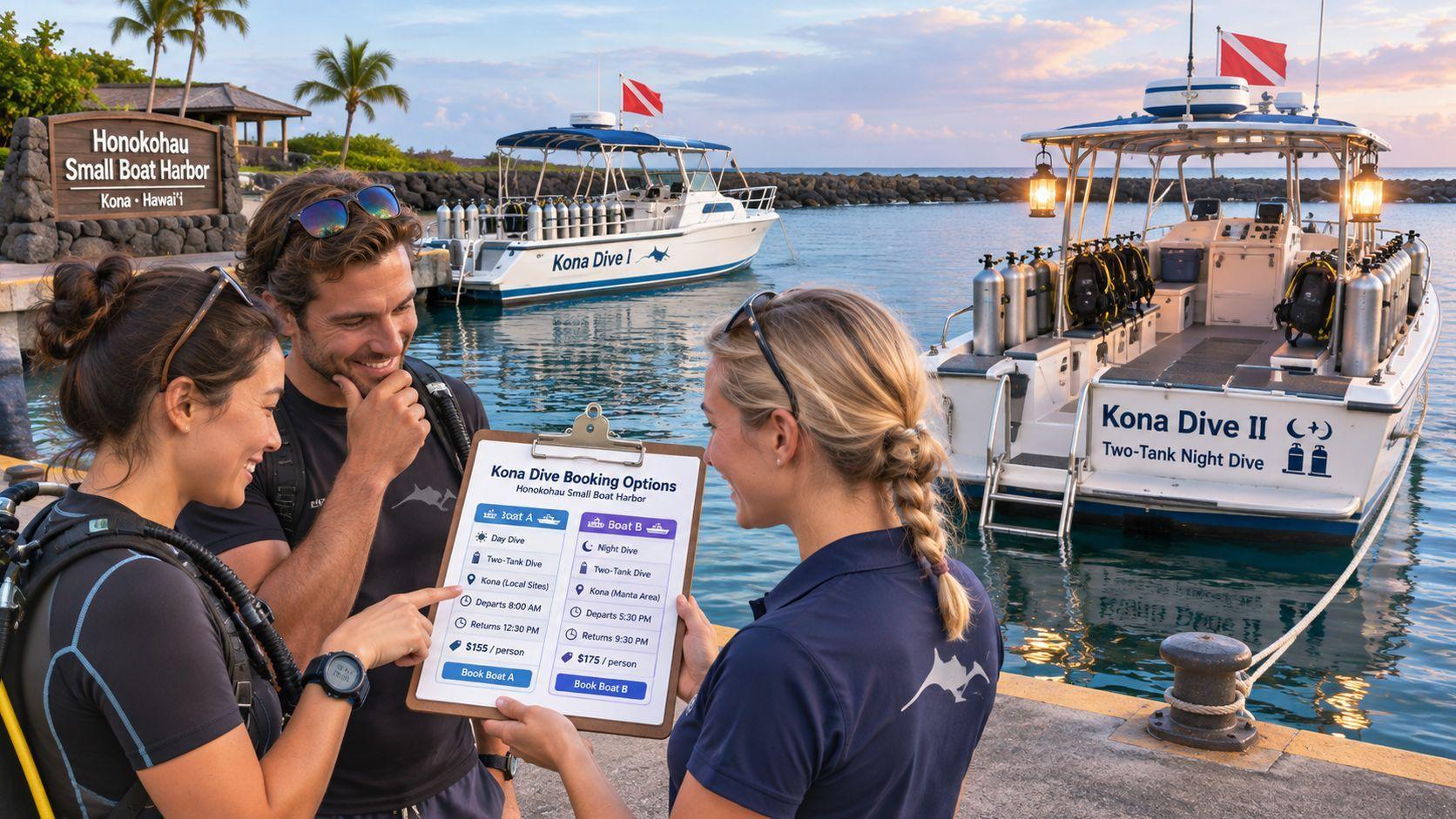
The operated trip, checked on the same criteria
Booking detail — This trip
Departure harbor — Honokohau Small Boat Harbor; the confirmation email gives the exact check-in spot and time
Departure window — 2:45 to 4:00 p.m., depending on sunset
Return window — 7:45 to 9:00 p.m.
Price — Up to $299 plus tax and fees, with pricing that varies by demand
Eligibility — Open Water certification or higher, a dive within the previous two years, ages 16 and up; divers under 18 dive with a parent or guardian
Equipment included — Two tanks, weights, a dive light, a guide for every six divers, and Nitrox for divers holding the required certification
Fallback if no mantas — The second dive becomes a night reef dive; cancellation or rebooking is permitted until 72 hours before departure
Judge the trip by that last row. Mantas appear on roughly 80% of dives, which makes the night reef dive a planned alternate outcome rather than a consolation invented on the dock. A crew that states the fallback and the rebooking cutoff in writing is showing you how it handles an empty site before your money is in.
Finish the booking with the details settled
- Verify eligibility. Have your certification card and recent diving record ready, and settle the guardian arrangement early if a diver under 18 is coming.
- Match the departure to your date. Sunset shifts the sailing time, so plan around the check-in stated in your confirmation rather than arriving at sailing time.
- Settle gas and gear. Confirm your Nitrox qualification if relevant and identify any rental needs before you reach the harbor.
- Read the terms. Keep the fallback plan and the 72-hour cancellation window in writing, especially when arranging several travelers.
- Reserve through the official website. Keep the confirmation, exact meeting spot, and check-in time available offline, and call 808-315-7114 for anything the site leaves open.
High-quality manta diving starts with that clarity, well before anyone switches on an underwater light.
Manta Ray Night Dive offers a guided evening combining an afternoon reef dive, a sunset meal, and an after-dark manta viewing at Garden Eel Cove. Visit Manta Ray Night Dive to check availability and settle your readiness, equipment, and fallback questions before booking.